How to Make Stronger Coffee: The Ultimate Guide to Bold Home Brewing
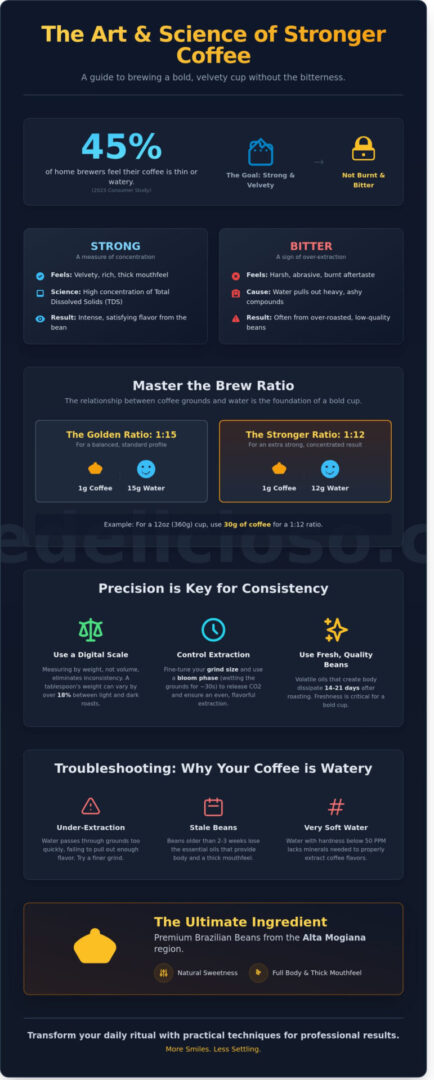
Why does that extra scoop of grounds often lead to a burnt, bitter mess rather than the bold, velvety cup you actually wanted? You likely believe that learning how to make stronger coffee simply means adding more caffeine or increasing the brewing temperature. It’s a common struggle; in fact, a 2023 consumer study found that 45 percent of home brewers feel their coffee tastes too thin or watery. You deserve a morning ritual that brings more smiles and less settling for mediocre results.
We’re here to help you master the science of coffee ratios and extraction to brew a bolder, stronger cup without the bitterness. By understanding how variables like the golden 1 to 15 ratio and water temperature impact your beans, you can achieve an intense but smooth flavor every time. This guide covers everything from grind size adjustments to the importance of specialty Brazilian Arabica so you can enjoy a thick mouthfeel and predictable results tomorrow morning.
Key Takeaways
- Understand the difference between coffee concentration and roast intensity to brew a cup that is truly bold rather than just bitter.
- Learn how to make stronger coffee by mastering the 1:15 golden ratio and adjusting your measurements for different brewing methods.
- Control extraction by fine tuning your grind size and using a bloom phase to prep your grounds for maximum flavor release.
- Explore how premium Brazilian beans from the Alta Mogiana region offer the natural sweetness and body needed for a superior bold profile.
- Transform your daily ritual with practical techniques that ensure professional results and more smiles in every sip.
Defining Coffee Strength: Concentration vs. Flavor Intensity
Finding that perfect, heavy bodied cup starts with understanding what strength actually means. In the world of specialty coffee, strength is not a measure of how dark the beans are or how much the flavor bites back. It is a precise scientific measurement of concentration. When you learn how to make stronger coffee, you are essentially learning how to increase the amount of dissolved coffee solids in your water.
Professional baristas use the term Total Dissolved Solids (TDS) to track this intensity. For a standard balanced brew, the TDS usually falls between 1.15 percent and 1.45 percent. The remaining 98.5 percent of your cup is simply water. While that sounds like a small amount of coffee material, a shift of even 0.1 percent creates a massive difference in how the liquid feels on your tongue. Various coffee brewing methods will yield different TDS levels based on the filter type, water temperature, and immersion time.
It is common to confuse “bold” roasts with “strong” coffee. A bold roast refers to the flavor profile created during the roasting process, often featuring smoky, toasted, or chocolatey notes. Strength, however, is about the brew ratio. You can brew a light roast to be incredibly strong or a dark roast to be thin and weak. True strength should feel velvety and rich, not harsh or abrasive. At Café Delicioso, we focus on the natural power of the bean to provide that “cup of joy” without needing to over-roast the life out of the coffee.
The Difference Between Strong and Bitter
Bitterness is frequently a sign of poor quality or technical error rather than true strength. When coffee is over-extracted, the water pulls out heavy, organic compounds that taste like ash or tobacco. This often happens with mass produced beans that are roasted excessively dark to mask defects. Coffee strength is the ratio of coffee solubles to water. Unlike bitterness, strength provides a satisfying mouthfeel and a dense concentration of the natural oils found in high quality Brazilian beans. It’s about the intensity of the experience without a burnt aftertaste.
Why Your Coffee Tastes Watery
If your morning ritual feels thin or sour, you are likely dealing with under-extraction. This happens when the water fails to wash enough flavor out of the grounds during the brewing cycle. Freshness is another critical factor. Specialty Arabica beans contain volatile oils that provide body, but these oils start to dissipate 14 to 21 days after roasting. If your beans are months old, they simply lack the material needed for a bold cup. Environmental factors play a role too. Water with a hardness level below 50 parts per million (ppm) often lacks the minerals necessary to “grab” the coffee flavors, leaving your brew tasting flat regardless of how many scoops you use. Learning how to make stronger coffee requires balancing these variables to ensure every drop is packed with authentic flavor.
Mastering the Brew Ratio for a Bolder Cup
The foundation of a bold cup starts with the brew ratio. This is the relationship between your coffee grounds and water. Most professionals recommend a 1:15 ratio as the Golden Ratio for a balanced profile. This means using 1 gram of coffee for every 15 grams of water. If you’re learning how to make stronger coffee, you need to manipulate these numbers with precision. Increasing the amount of coffee without adding more water results in a higher concentration of total dissolved solids. This creates that heavy, syrupy mouthfeel that defines a premium Brazilian brew. Taste the difference in quality without compromise!
Consistency is the heartbeat of a great morning ritual. Without a digital kitchen scale, you’re essentially guessing. A tablespoon of light roast beans weighs significantly more than a tablespoon of dark roast beans because dark roasting removes more moisture, making the beans less dense. You might think you’re using the same amount every day, but the weight could vary by 18 percent or more. This inconsistency is why your coffee tastes incredible on Tuesday but weak on Wednesday. We believe in More Smiles. Less Settling. and that starts with a predictable, delicious result every single morning.
Calculating Your Coffee to Water Ratio
To achieve an extra strong result, transition to a 1:12 ratio. This concentrated recipe uses 30 grams of coffee for every 360 grams of water. It’s a bold choice that highlights the deep, chocolatey notes of our authentic specialty beans from the Alta Mogiana region. Whether you’re brewing a single 12 ounce cup or a full 40 ounce carafe, keep the math consistent. Scaling is simple; multiply your desired water weight by 0.083 to find the exact grams of coffee needed for a 1:12 strength. This precision reflects a genuine love for the process.
Measuring by Weight vs. Volume
Weight provides a level of accuracy that volume simply cannot match. 20 grams of coffee is always 20 grams, regardless of bean size or roast level. Tablespoons measure volume, which is deceptive. A scoop of large beans has much more air gap than a scoop of smaller, denser beans. If you don’t have a scale, level off your scoops every time to minimize errors. However, to truly master how to make stronger coffee, a digital scale is the best investment. It ensures every cup is crafted with compassion. You can find your next favorite roast in our online shop.
Optimizing Extraction with Grind Size and Temperature
Learning how to make stronger coffee requires a deep dive into the science of extraction. Think of extraction as the process of pulling the life out of the bean and into your mug. Grind size is your primary tool for controlling surface area. When you grind your beans, you expose the inner cells to water. A finer grind creates more surface area; this allows water to dissolve coffee solids much faster. If your brew tastes weak, your grounds might be too large for the contact time you’ve provided. Our premium Brazilian beans deserve a precise touch to reveal their full potential.
Finding the Right Grind for Your Method
Finer grinds are essential for quick brewing methods like espresso or the Aeropress. These methods use pressure or short durations to pull flavor, so they need the maximum surface area available to increase strength quickly. Conversely, immersion methods like the French Press require a coarse, sea salt consistency. Using fine grounds in a French Press leads to over-extraction and a muddy, bitter sludge that masks the authentic notes of the Alta Mogiana region. We always recommend using a burr grinder. Unlike blade grinders that shatter beans into uneven shards, a burr grinder produces uniform particles. This consistency ensures every grain extracts at the same rate, providing an incomparable balance in every cup.
The Role of Water Temperature in Boldness
Heat acts as the catalyst for flavor. The Specialty Coffee Association identifies the sweet spot for water temperature between 195 and 205 degrees Fahrenheit. Within this range, the water has enough thermal energy to break down the complex organic compounds and oils that give coffee its body and strength. Heat increases the solubility of coffee oils, allowing them to blend seamlessly into your brew. If your water is cooler than 195 degrees, you’ll likely end up with a cup that feels thin, sour, and under-extracted. This is because the water doesn’t have the energy required to pull out the heavier, sweeter molecules.
Be careful with boiling water. Pouring water at 212 degrees directly onto delicate Arabica beans can scorch them. This creates a harsh, burnt flavor that ruins the “Love for the Process” we put into every roast. Let your kettle sit for about 60 seconds after boiling to reach that perfect 200-degree mark. This small adjustment ensures you get more smiles and less settling in your morning ritual. By mastering the relationship between heat and grind, you’ve taken the most important step in understanding how to make stronger coffee at home.
- 195 to 205°F: The ideal temperature range for maximum flavor extraction.
- Burr Grinder: The only way to ensure uniform grounds for a clean, bold taste.
- 60 Seconds: The time you should wait after boiling to avoid scorching your beans.
Experience the difference that proper technique makes. When you respect the beans and the science of the brew, you create a cup of joy that’s truly exceptional. Visit our online shop to find the perfect roast for your next bold experiment.
Step-by-Step Methods for Stronger Home Brewing
Mastering how to make stronger coffee requires more than just adding extra scoops to the basket. It involves managing the relationship between water and grounds to ensure every ounce of flavor is extracted without bitterness. The first step for any manual method is the bloom phase. Pour exactly double the weight of your coffee in water over the grounds and wait 30 seconds. This releases carbon dioxide, which otherwise acts as a barrier that prevents water from fully saturating the coffee particles.
Strengthening Your Drip and Pour Over Coffee
To increase intensity in a pour over, focus on your pour speed. A slower, pulsed pour increases the contact time between the water and the grounds. If you find your coffee feels thin, try a 1:15 ratio, which uses 15 grams of water for every 1 gram of coffee. This is a tighter ratio than the standard 1:17 specialty coffee association recommendation.
The double filter method is often debated among enthusiasts. While using two paper filters does slow down the drainage and increase contact time, it often traps the essential oils that provide body. Instead of doubling up on paper, refer to our Hario V60 guide to learn how grind size adjustments can achieve that same bold profile without stripping away the coffee’s natural character. For drip machines, simply ensuring the showerhead is clean can improve water distribution, leading to a more uniform and potent extraction.
Maximizing Boldness in French Press and AeroPress
Immersion brewing is the gold standard for body and weight. For a heavy, syrupy French Press, follow the four minute steep rule. After the initial four minutes, use a spoon to break the crust of grounds on top and let it sit for another three minutes before pressing. This 7 minute total time allows the finest particles to settle, resulting in a cleaner yet much bolder cup. Don’t forget to stir the grounds twice during the initial pour to ensure no dry pockets remain.
The AeroPress offers a unique opportunity for concentration. Use the inverted method by turning the device upside down during the steep. This prevents any water from leaking through the filter prematurely. By using a fine grind and a 60 second steep, you create a concentrated, espresso-like base that stands up beautifully to milk or cream. If you use a pod-based machine, you can mimic this intensity by selecting the 6 ounce setting instead of 8 or 10 ounces. This prevents the over-extraction of bitter woody notes that occur at the end of a longer brew cycle.
Finding your personal strength preference is a journey of small adjustments. If your current brew feels weak, increase your steep time by 30 second increments until the profile matches your taste. Experience the difference that premium, responsibly sourced beans make by visiting our coffee shop today.
The Role of Premium Brazilian Beans in a Strong Cup
Choosing the right bean is the most critical step when you want to learn how to make stronger coffee. The origin of your coffee dictates the base flavors and the physical weight of the brew on your palate. Brazilian beans are world-renowned for their low acidity and heavy body, making them the perfect foundation for a bold cup. While high-acid beans from other regions can taste thin or sharp when brewed at high concentrations, Brazilian coffee maintains a creamy, mouth-coating texture that feels substantial.
The Alta Mogiana region in Brazil is particularly special. This area sits at altitudes between 900 and 1,250 meters, providing the ideal climate for coffee cherries to ripen slowly. This slow maturation develops natural sugars that survive the roasting process. We source our beans through the Cocapec cooperative to ensure every bag reflects the authentic, bold profile of this land. By utilizing regenerative farming and pesticide-free methods, we preserve the purity of the flavor. You get a cup that is strong because of its quality, not because of chemical additives or over-roasting.
Brazilian Arabica: Naturally Bold Without the Burn
Many people confuse strength with bitterness. They assume that a strong cup must have a harsh, burnt aftertaste. This is often the result of using low-quality Robusta beans, which contain more caffeine but lack flavor complexity. We use 100 percent Arabica beans because they offer a sophisticated strength. You will experience deep chocolate and toasted nut notes that define our coffee. Arabica contains more natural oils and sugars than Robusta, which creates a rich flavor profile that stands up to milk and cream without losing its identity.
Our commitment to quality means you never have to settle for a cup that tastes like ash. We believe that strength should be an invitation, not a chore. When you understand how to make stronger coffee using the right beans, you unlock a world of sweetness and depth that cheaper alternatives simply cannot provide. This balance of power and smoothness is what makes Brazilian Arabica the gold standard for home brewers who want a kick without the burn.
Fresher Beans for a More Impactful Cup
Freshness is the secret weapon of home brewing. After roasting, coffee beans undergo a degassing process where they release carbon dioxide. If beans sit on a shelf for months, they lose the aromatic compounds and oils that provide that “strong” punch. We manage the entire journey from the land to your doorstep to ensure you receive beans at their peak potential. This freshness translates directly into a more impactful cup with a vibrant aroma and a lingering finish.
Our mission is built on the idea of More Smiles. Less Settling. This starts with a deep respect for the land and the people who harvest it. By providing affordable, premium Brazilian coffee, we ensure that your morning ritual is always a cup of joy. You don’t have to compromise on ethics or taste to get the bold energy you need. You can learn more about our commitment to quality and ethics by exploring our mission. We believe everyone deserves a strong, delicious start to their day.
Elevate Your Daily Brewing Ritual
Mastering how to make stronger coffee comes down to precision and the quality of your ingredients. By adjusting your brew ratio and keeping your water temperature between 195 and 205 degrees Fahrenheit, you ensure every ounce of flavor is extracted properly. It’s about moving beyond a simple caffeine kick to find a cup that’s truly bold and satisfying. True strength isn’t just concentration; it’s the depth of character in every sip.
Our 100% Arabica beans from the Alta Mogiana region provide the perfect foundation for your home brewing. We source these beans through regenerative farming practices because we believe in love for the land and the people. With dozens of 5-star reviews celebrating our rich, incomparable taste, we’re confident you’ll feel the difference in your very first cup. You don’t have to settle for a weak morning routine when premium Brazilian quality is within reach.
Shop our fresh, bold Brazilian coffee beans today and bring more smiles to your kitchen. You have the tools and the knowledge to brew something exceptional. It’s time to enjoy the bold statement your morning deserves.
Frequently Asked Questions About Brewing Strong Coffee
How much coffee should I use for a strong cup?
Use a 1:15 ratio for a robust cup, which equates to about 2 tablespoons of grounds for every 5 ounces of water. This represents a 15 percent increase in coffee grounds compared to the standard 1:17 golden ratio used by many professionals. For a standard 10 ounce mug, you’ll want to measure out 20 grams of beans to ensure a deep, satisfying flavor profile.
Does a finer grind make coffee stronger?
A finer grind increases the surface area of the bean, which allows the water to extract more oils and flavors in a shorter period. When you’re learning how to make stronger coffee, shifting from a medium grind to a medium-fine setting, similar to the texture of table salt, is a highly effective tactic. This adjustment ensures more of the coffee’s internal compounds reach your cup, resulting in a more concentrated and intense brew.
Does dark roast coffee have more caffeine than light roast?
Dark roast coffee actually contains slightly less caffeine by volume because the beans lose mass and caffeine content during the longer roasting process. A light roast bean is denser and typically retains about 1.2 percent caffeine by weight, while a dark roast might drop to 1.1 percent. However, dark roasts provide the smoky, bold flavor that many people associate with a strong cup of joy.
Why does my coffee taste bitter when I try to make it stronger?
Bitterness is usually a sign of over-extraction, which occurs when grounds stay in contact with water for too long or the water is too hot. If your brewing time exceeds 5 minutes or your water temperature is above 205 degrees Fahrenheit, you’ll extract harsh tannins. To fix this, try using a slightly coarser grind or shortening your brew time by 30 seconds to maintain a bold yet smooth taste.
What is the best coffee to water ratio for a bold flavor?
A 1:13 or 1:14 ratio is the best choice for those who want an exceptionally bold and viscous mouthfeel. This means you’ll use 1 gram of coffee for every 13 or 14 grams of water. For a standard 350 milliliter serving, you would use approximately 25 to 27 grams of coffee. This concentrated approach highlights the authentic, nutty characteristics of premium Brazilian beans without any watery finish.
Can I make strong coffee in a standard drip machine?
You can make a bold cup in a drip machine by increasing your coffee-to-water ratio and using high-quality Arabica beans. Since most home machines have a fixed water temperature, your primary tool for strength is the amount of grounds you add. Try using 3 tablespoons of coffee for every 6 ounces of water. This simple change ensures your morning ritual delivers the intense flavor you crave without needing expensive new equipment.
Does the water temperature really matter for coffee strength?
Water temperature is vital because it determines how efficiently the water acts as a solvent to pull flavors from the grounds. The Specialty Coffee Association recommends a temperature between 195 and 205 degrees Fahrenheit for the best results. If your water is below 190 degrees, it won’t extract the necessary oils and acids, leaving your coffee tasting thin and sour. Using a thermometer helps you hit that 200 degree sweet spot consistently.
How do I make my coffee stronger without adding more caffeine?
To increase flavor intensity without a caffeine spike, focus on the roast profile and your brewing method. Choosing a dark roast provides a heavier body and more intense flavor notes while naturally containing slightly less caffeine than lighter roasts. You can also use a French press to allow more natural oils and fine particles into your mug. This creates a rich, textured experience that feels much stronger on the palate without the extra jitters.