
Colombian Arabica Coffee: A Guide to the World’s Most Beloved Bean
Ever stand in the coffee aisle, overwhelmed by terms like ‘Arabica’ and ‘100% Colombian,’ and wonder what they truly mean for your morning cup? You deserve more than just a guess-you deserve a coffee experience that is consistently exceptional. We believe nothing should come between you and your cup of joy, which is why we’re exploring the world of premium colombian arabica coffee, a bean celebrated for its incredible quality and uniquely satisfying flavor.
Forget the fear of buying another bland or bitter bag. In this guide, we’ll uncover the secrets that make this coffee a global favorite. You will discover its rich story, learn to identify the markers of authentic, high-quality beans, and finally understand the bright, balanced, and beautifully smooth taste profile to expect. Get ready to choose your next coffee with confidence and passion. It’s time for more smiles and less settling in every single sip.
Key Takeaways
- Discover how Colombia’s unique mountain geography and climate create the perfect conditions for growing exceptional coffee.
- Explore the compassionate, hands-on methods used by small family farms that define the quality and heart behind every cup.
- Identify the signature smooth, well-balanced flavor profile of premium colombian arabica coffee and learn what to look for on the bag.
- Master the key to buying better coffee by understanding why “single-origin” is your best indicator of quality and authentic taste.
What Exactly Is Colombian Arabica Coffee?
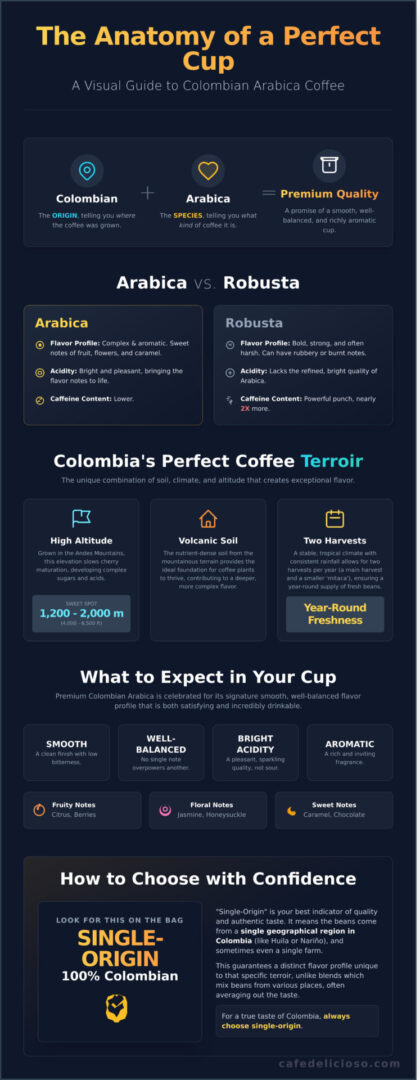
When you see “100% Colombian Arabica” on a bag of coffee, it’s easy to get confused. Are they the same thing? Not quite. Think of it this way: ‘Colombian’ is the origin, telling you where the coffee was grown. ‘Arabica’ is the species, telling you what kind of coffee plant it is. The two together signify a premium coffee experience, as Colombia has built its stellar reputation on almost exclusively growing high-quality Arabica beans.
The country’s unique mountainous terrain, volcanic soil, and tropical climate create the perfect conditions for these delicate plants to thrive. This commitment to a single, superior species is why authentic colombian arabica coffee is celebrated worldwide for its consistently smooth, well-balanced, and richly aromatic profile. It’s a promise of quality that starts right at the source.
Arabica vs. Robusta: The Fundamental Difference
To truly appreciate Arabica, it helps to know its counterpart, Robusta. These are the two most popular coffee species, but they deliver vastly different experiences in your cup. The specialty coffee world prizes Arabica for its nuanced and delightful flavors.
- Arabica Beans: Known for their complex and aromatic profiles. They have a bright, pleasant acidity with sweet notes of fruit, flowers, and caramel. They also contain significantly less caffeine than Robusta.
- Robusta Beans: Deliver a bold, strong, and often harsh flavor, sometimes with rubbery or burnt undertones. They pack a powerful punch with nearly double the caffeine content, but lack the refined taste of Arabica.
Why ‘100% Colombian Coffee’ is a Mark of Quality
Colombia doesn’t just grow exceptional coffee; it has masterfully branded it as a symbol of trust and excellence. This dedication to quality has deep roots in the history of Coffee production in Colombia, driven largely by the influential National Federation of Coffee Growers of Colombia (FNC). For decades, the FNC has implemented rigorous quality control standards and launched brilliant marketing campaigns, like the iconic Juan Valdez character, to represent the hardworking coffee farmer.
This strategic effort built a powerful global identity, ensuring that when you choose 100% Colombian coffee, you’re not just buying beans-you’re investing in a legacy of passion, consistency, and an unparalleled cup of joy.
The Secret in the Soil: Colombia’s Perfect Coffee Terroir
Ever wonder why a wine from one valley tastes completely different from another? The secret is terroir-the unique combination of soil, climate, and altitude that shapes its final character. In the world of premium coffee, terroir is everything. It’s the invisible ingredient that transforms a simple bean into an exceptional cup of joy. And Colombia’s unique geography creates the perfect stage for growing world-class Arabica beans.
Nestled in the heart of South America, Colombia is defined by the majestic Andes Mountains, which split into three distinct mountain ranges, or cordilleras. This dramatic landscape creates countless valleys and slopes with the high altitudes and stable temperatures that Arabica plants crave. Add to that the rich, nutrient-dense volcanic soil, and you have the ideal recipe for producing exceptional colombian arabica coffee with deep, complex flavors.
The ‘Eje Cafetero’: Colombia’s Famous Coffee Triangle
At the heart of this landscape lies the famous “Eje Cafetero,” or Coffee Triangle. This UNESCO World Heritage site, comprising the regions of Caldas, Risaralda, and Quindío, boasts perfect microclimates for cultivation. Beyond the triangle, other renowned regions like Huila, Nariño, and Sierra Nevada are celebrated for producing some of the most sought-after single-origin beans, each with its own distinct and delicious character.
Altitude and Acidity: The Science Behind the Flavor
So, why is high altitude so important? At elevations between 1,200 and 2,000 meters (4,000-6,500 feet), coffee cherries ripen more slowly. This extended maturation allows more complex sugars and acids to develop, creating a denser bean. The result is a cup with a bright, sparkling acidity-a desirable quality that brings the coffee’s fruit and floral notes to life. This isn’t sourness; it’s the vibrant signature of high-quality Arabica.
Consistent Climate and Two Harvests a Year
Unlike many coffee-growing countries with a single annual harvest, Colombia’s stable, tropical climate and consistent rainfall bless it with two. The main harvest is followed by a second, smaller harvest known as the mitaca. This incredible advantage ensures a year-round supply of fresh green coffee, allowing us to deliver the freshest possible colombian arabica coffee to your cup. It’s a promise of quality you can truly taste.
From Cherry to Cup: The Human Touch in Colombian Coffee
While the Arabica species provides the genetic blueprint for excellence, the true character of exceptional coffee is shaped by human hands. In Colombia, this story is deeply personal. The vast majority of coffee isn’t grown on massive industrial plantations but on small, family-owned farms known as fincas. Here, generations of farmers pour their passion and expertise into every harvest, a process “crafted with compassion” from start to finish.
This dedication is most evident during the harvest. Coffee cherries on the same branch ripen at different times, and only the perfectly ripe, deep-red ones contain the sweet and complex flavors we cherish. Farmers meticulously hand-pick each cherry one by one, leaving unripe green ones to mature. This labor-intensive step is crucial-it prevents the sour, bitter notes of under-ripe beans from ever tainting your cup.
Washed Processing: The Key to a Clean, Crisp Cup
The signature clean and bright taste of colombian arabica coffee comes from a method called washed processing. After picking, the skin and fruit pulp are washed away from the bean before it’s dried. This meticulous process highlights the bean’s intrinsic flavors-its acidity, sweetness, and nuanced notes-without influence from the fruit. Unlike natural processing, where the fruit dries on the bean and imparts jammy flavors, the washed method delivers an exceptionally clean, vibrant, and consistent cup.
Understanding Colombian Coffee Grades: Supremo vs. Excelso
When you see “Supremo” or “Excelso” on a bag, you’re looking at a mark of quality, but it might not mean what you think. This grading system is based purely on the physical size of the bean, not its flavor. Supremo beans are the largest, and Excelso beans are slightly smaller. Both represent the highest quality exports from Colombia, meticulously sorted to ensure you receive only the best beans from the harvest. Think of them as two top-tier selections, ready to deliver a premium experience.
What Does Colombian Arabica Coffee Taste Like?
When you think of a classic, exceptional cup of coffee, you’re likely imagining the taste of Colombian Arabica. It’s renowned worldwide for its incredibly smooth, mild, and well-balanced profile. This isn’t a coffee that overwhelms the palate; instead, it delivers a consistently satisfying and comforting experience, making it the perfect foundation for your daily coffee ritual. It’s a true crowd-pleaser for a reason.
The magic of colombian arabica coffee lies in its delightful complexity and harmony. It features a medium body that feels just right-not too heavy, not too light-complemented by a bright, pleasant acidity that adds a clean, crisp finish to every sip. Expect to find a beautiful symphony of tasting notes:
- Citrus: A gentle brightness, often like sweet orange or lemon.
- Nuts: A smooth, mellow nuttiness, reminiscent of walnuts.
- Chocolate: Rich milk chocolate notes that deepen with a darker roast.
- Caramel: A sweet, buttery finish that ties all the flavors together.
Finding Your Favorite Flavor Profile
While there’s a classic profile, the flavor can vary beautifully based on where the beans are grown and how they are roasted. Coffee from the high-altitude Nariño region might offer more delicate, floral notes, while beans from Santander can present a richer, earthier character. The roast level also plays a huge role; a light roast will highlight that bright citrus acidity, while a medium or dark roast brings forward those delicious chocolate and caramel notes.
Best Brewing Methods to Highlight its Flavors
To truly unlock the exceptional flavors of your beans, choose a brewing method that matches your taste. A pour-over brewer like a V60 will accentuate the coffee’s bright acidity and clarity. For a classic, balanced cup that’s perfect every morning, a standard drip coffee maker is an excellent choice. If you prefer a richer, fuller-bodied experience with more oils, a French press will deliver a robust and deeply satisfying cup of joy.
How to Choose Quality Coffee: Lessons from Colombia and Beyond
Understanding what makes 100% Arabica special is the first step. Now, let’s turn that knowledge into action. The same principles that elevate world-class colombian arabica coffee can guide you to your next favorite bag, no matter where it comes from. Here’s what to look for to ensure every cup is a cup of joy.
When you’re at the store or browsing online, keep these three things in mind:
- Look for ‘Single-Origin’: This label means the beans come from a specific farm, cooperative, or region. It’s your guarantee of traceability and a unique flavor profile, not a generic, mass-produced blend.
- Check the Roast Date: Freshness is non-negotiable for exceptional coffee. Always look for a “Roasted On” date, not a “Best By” date. The most vibrant flavors are enjoyed within a few weeks of roasting.
- Go Beyond the Country: Instead of just “Colombia” or “Brazil,” look for specific regions and tasting notes. A bag that lists “Huila” with notes of “caramel and citrus” tells a much richer story than one that doesn’t.
The Single-Origin Promise: From Colombia to Brazil
These principles of quality are universal. Just as Colombia’s Eje Cafetero is celebrated for its balanced and bright beans, Brazil’s Alta Mogiana region is renowned for producing exceptionally smooth and rich Arabica. Great coffee is about place and purpose. It’s a story that begins at the source, whether in the mountains of Colombia or the sun-drenched hills of Brazil.
Our Commitment to Quality: A Shared Philosophy
We believe in this philosophy wholeheartedly. It’s why we source our beans with such care, championing regenerative farming and ethical partnerships. Our coffee is crafted with compassion, ensuring that our love for the people and the land is present in every sip. We share the same passion for quality that defines the best colombian arabica coffee producers-it’s about more smiles and less settling. If you love balanced, premium Arabica, explore our single-origin Brazilian coffee.
From Colombia’s Slopes to Your Cup of Joy
As we’ve explored, the magic of colombian arabica coffee lies in more than just the bean itself. It’s a story of unique terroir, where rich volcanic soil and ideal altitudes create a perfectly balanced flavor profile. It is also a testament to the human touch-the passionate farmers whose dedication transforms a simple cherry into the world-renowned coffee we cherish. Understanding this journey is the first step toward appreciating exceptional coffee, wherever it comes from.
This appreciation for quality and compassion is the heart of what we do. If your journey has inspired a passion for authentic Arabica, we invite you to continue the exploration. Our single-origin 100% Arabica beans are ethically sourced and crafted with compassion. They are pesticide-free and grown using regenerative farming, ensuring every cup is a moment of pure joy. Appreciate quality Arabica? Discover our ethically sourced coffee from Brazil’s famed Alta Mogiana region.
Your perfect coffee ritual is waiting. It’s time for more smiles and less settling. Happy brewing!
Frequently Asked Questions
Is Colombian coffee stronger than other coffees?
The word “strong” can refer to caffeine or flavor. Colombian coffee, being 100% Arabica, is celebrated for its rich, full-bodied flavor and bright acidity, not for having the highest caffeine content. Beans like Robusta typically contain more caffeine. So, while a cup of Colombian coffee delivers a bold and satisfying taste experience, it offers a beautifully balanced strength in flavor rather than an overwhelming jolt of caffeine. It’s a truly exceptional cup.
What is the difference between Colombian and Brazilian coffee?
The main difference lies in the flavor profile, which is shaped by growing conditions and processing methods. Colombian beans are typically washed, which creates a cleaner, brighter cup with higher acidity and notes of citrus and fruit. In contrast, Brazilian coffees are often naturally processed, resulting in a cup with lower acidity, a heavier body, and sweet, nutty, or chocolatey flavors. Both offer an authentic and premium coffee experience, just with wonderfully different personalities.
Is all coffee from Colombia 100% Arabica?
Yes, it is! Colombia has a unique commitment to quality, and by law, only 100% Arabica coffee beans can be grown and exported. This national regulation, upheld by the Colombian Coffee Growers Federation (FNC), ensures that every bag with the “Café de Colombia” logo represents the highest standard. This guarantee is a major reason why Colombian coffee is trusted around the world for its consistent, premium quality and exceptional taste.
Should I buy light, medium, or dark roast Colombian coffee?
The perfect roast depends on the experience you want in your cup of joy. A light roast will preserve the bean’s origin flavors, highlighting bright acidity and floral or fruity notes. A medium roast offers a beautiful balance of acidity and body, often with caramel or nutty undertones. For a bolder, smokier flavor with low acidity, a dark roast is the ideal choice. We recommend trying a medium roast first to experience the classic, balanced profile.
Why is Colombian coffee so famous around the world?
Colombian coffee’s fame comes from a perfect blend of geography and dedication. The country’s mountainous terrain provides the ideal altitude and climate for growing high-quality Arabica beans. This, combined with a national commitment to quality control and the passionate work of millions of small-farm growers, creates an incomparable flavor profile. The exceptional quality and consistency of colombian arabica coffee have made it a beloved standard for coffee lovers everywhere, a true symbol of excellence.
What does ‘Supremo’ mean on a bag of Colombian coffee?
‘Supremo’ is a grading term for colombian arabica coffee that refers to the size of the bean. Supremo beans are the largest and most uniform, passing through a 17/18 screen size. While bean size doesn’t single-handedly guarantee superior flavor, it is an indicator of meticulous sorting and quality control. It signifies that you are getting the largest beans from a harvest, which are often associated with a rich, well-rounded, and exceptionally consistent cup.