Direct Trade Coffee vs Fair Trade: Which Ethical Choice Is Better for Your Brew?
Paying a premium for an ethical seal doesn’t always mean the farmer is seeing a life-changing profit. While many shoppers reach for certified bags to feel good about their purchase, a 2023 study by the International Coffee Organization found that some smallholder farmers still live below the poverty line despite being part of global certification programs. It’s a confusing reality when you’re just trying to enjoy a cup of joy without compromising your integrity. You likely feel that choosing between direct trade coffee vs fair trade shouldn’t require a degree in economics just to ensure a farmer gets a fair shake.
At Café Delicioso, we believe in love for the people and the land, which is why we want to clear up the noise. You’ll discover how each sourcing model changes the flavor of your coffee and the quality of life for producers in regions like Alta Mogiana. We’ll show you how to find exceptional specialty beans that fit your budget while ensuring farmers receive up to 50 percent more than the standard market rate. This guide provides the clarity you need to find a brew that balances high quality with genuine compassion, ensuring more smiles and less settling for everyone involved.
Key Takeaways
- Learn how Fair Trade serves as a global safety net by ensuring minimum prices and funding essential community projects for small cooperatives.
- Understand how direct trade models remove intermediaries to increase farmer profits and drive the exceptional quality scores found in specialty coffee.
- Evaluate the core differences of direct trade coffee vs fair trade to decide if you prefer supporting broad price stability or transparent quality-focused relationships.
- Discover how sourcing coffee with a focus on the people and the land ensures you enjoy a premium brew that remains affordable and ethically produced.
- Gain the clarity needed to select a coffee that matches your commitment to environmental sustainability and fair labor practices.
Understanding the Basics: What Is Fair Trade and Direct Trade Coffee?
Your morning coffee ritual is shifting from a simple caffeine fix to a conscious choice for global good. For decades, the coffee industry operated on a system that often left small farmers vulnerable to poverty and market crashes. Today, ethical consumption isn’t just a trend; it’s a necessity. At Café Delicioso, we believe in “More Smiles. Less Settling.” This philosophy drives us to look beyond the bag and understand the lives of the people who harvest our beans. When you compare direct trade coffee vs fair trade, you’re looking at two different paths toward the same goal: a sustainable, compassionate coffee industry.
The rise of these labels reflects a growing demand for transparency. Consumers now want to know that their “cup of joy” didn’t come at the cost of human dignity. These models provide frameworks to ensure that the 12.5 million smallholder farmers who produce most of the world’s coffee can actually afford to stay in business. Choosing between them requires understanding how they impact the land and the laborers in regions like Alta Mogiana, Brazil.
The Origins of Fair Trade Certification
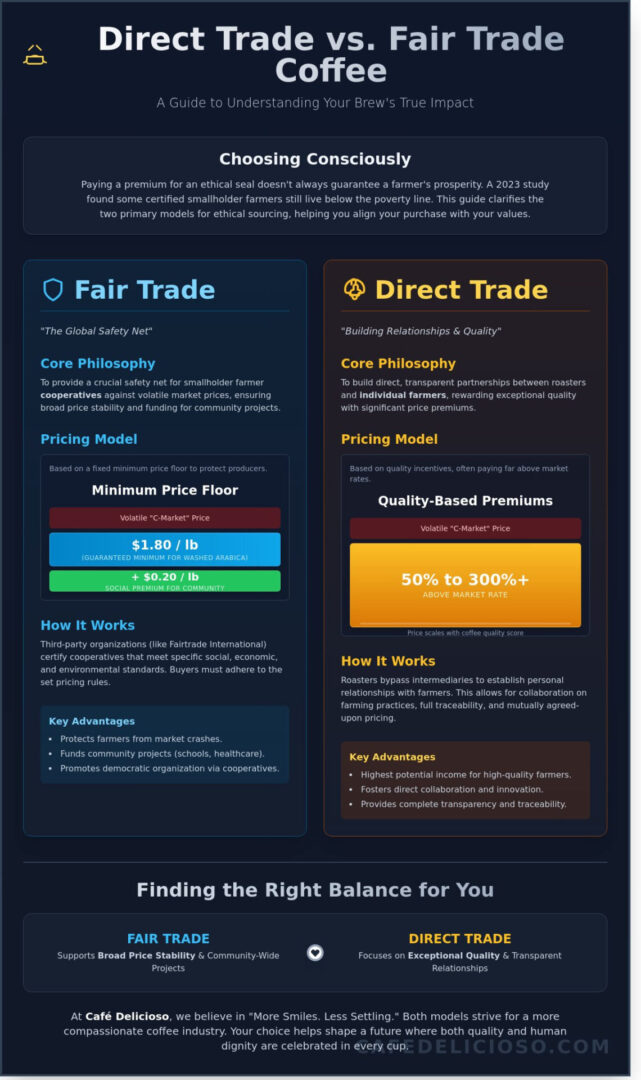
The movement gained global momentum in 1988 with the launch of the Max Havelaar label in the Netherlands. This was a direct response to the 1989 collapse of the International Coffee Agreement, which caused prices to plummet. Third-party organizations like Fairtrade International stepped in to create a safety net. They established a minimum price floor that protects farmers when the global market price drops below sustainable levels. Currently, Fair Trade coffee standards require a minimum price of $1.40 per pound for washed Arabica. Additionally, cooperatives receive a “social premium” of 20 cents per pound. These funds go directly into community projects like building schools or improving local healthcare facilities.
The Evolution of Direct Trade
In the early 2000s, specialty roasters began to feel that standard certifications didn’t go far enough to reward exceptional quality. They started bypassing traditional brokers to work directly with farmers. This relationship-based model focuses on quality incentives rather than just price floors. Instead of a flat minimum, a roaster might pay 50% to 300% above the market rate for a specific micro-lot with a high cupping score. This direct communication allows roasters to request specific farming practices, such as regenerative agriculture or shade-grown techniques. It turns the transaction into a partnership. When roasters and farmers talk directly, they can solve problems together, leading to better beans and more stable incomes for the families involved.
Understanding the difference between direct trade coffee vs fair trade is essential for the future of the industry. Both models aim to combat the volatility of the “C-market” price, which can swing wildly based on speculation rather than the actual cost of production. While Fair Trade provides a vital safety net for large cooperatives, Direct Trade offers a pathway for individual farmers to earn a premium for their craftsmanship. At Café Delicioso, we see this as “Love for the People” in action. By supporting models that prioritize the farmer’s well-being, we ensure that specialty coffee remains a viable path for the next generation of growers. This commitment to ethical production is why we focus on “Crafted with Compassion,” ensuring every bean tells a story of respect and quality.
Fair Trade Coffee: The Global Safety Net for Producers
Fair Trade operates as a vital shield for the smallholder farmers who produce 80% of the world’s coffee. The system relies on the Fair Trade Minimum Price to protect families from the volatile “C market” price swings. This price acts as a financial floor. When global market rates crash, Fair Trade buyers must still pay the established minimum. In August 2023, Fair Trade International increased this minimum price for washed Arabica to $1.80 per pound. This adjustment helps farmers cover the rising costs of production and climate change adaptation. This protection ensures families don’t lose their ancestral land during seasonal market downturns. It is about providing a baseline of dignity through Love for the People.
Beyond the base price, buyers pay a Fair Trade Premium of $0.20 per pound. These funds do not go to individual bank accounts; they belong to the farmer cooperatives. Members vote democratically on how to invest this money into their own neighborhoods. Data shows that roughly 31% of these premiums fund community infrastructure. This includes building local schools, funding mobile health clinics, and improving clean water access. This collective bargaining power gives smallholders a voice in a global industry that often ignores individual voices. However, the model faces valid scrutiny. The heavy bureaucracy required to manage these cooperatives often leads to high administrative costs that eat into the potential profits for the actual growers.
The Impact of Third-Party Oversight
Consumers look for the recognized blue and green seal because it represents a promise of ethical production. Rigorous audits conducted by organizations like FLOCERT ensure farms follow strict labor standards and environmental regulations. These rules prohibit forced child labor and mandate the reduction of harmful pesticides. This oversight builds a bridge of trust between your morning ritual and the farm. While this oversight is valuable, it creates a financial barrier. A small cooperative might pay over $3,000 for its initial certification plus ongoing annual fees. For a farmer earning less than $2 a day, these costs feel heavy. This barrier sometimes excludes the smallest, most vulnerable producers from the very system designed to help them.
Limitations of the Fair Trade Model
The conversation regarding direct trade coffee vs fair trade often highlights a gap in quality incentives. The Fair Trade model is a safety net rather than a reward for exceptional flavor. If the market price falls below the Fair Trade floor, a farmer might sell their lower quality beans to the certification body to secure the guaranteed price. They often save their best, high scoring harvests for specialty buyers who pay more for taste. This dynamic can lead to a “low bar” problem where the certification doesn’t always translate to a premium experience in your cup.
An academic analysis of trade models suggests that while Fair Trade provides essential stability, it may not offer the same long term financial growth as direct relationships. Much of the premium is absorbed by cooperative management or the costs of maintaining the certification itself. This means the actual cash reaching a farmer’s pocket is sometimes only a small fraction of the extra price you pay at the register. At Café Delicioso, we believe every cup of joy should be crafted with compassion and transparency. Comparing direct trade coffee vs fair trade shows that while the safety net is important, it is only one part of the story in the journey toward a truly sustainable coffee industry.
Direct Trade Coffee: Building Relationships and Quality
Direct trade is more than a transaction; it’s a commitment to the people who grow your morning cup of joy. By removing the long chain of exporters, brokers, and international wholesalers, roasters put more money directly into the hands of farmers. Traditional supply chains often involve five or six intermediaries. Each one takes a cut of the profit, leaving the producer with the smallest slice. Direct trade collapses this distance into a single, transparent bridge. It allows for a “Love for the People” that translates into real financial security for farming communities.
Transparency is the backbone of this model. We don’t just know the country of origin; we know the specific plot of land and the family managing the soil. In the Alta Mogiana region of Brazil, this level of detail is standard. This region, sitting at altitudes between 900 and 1,200 meters, produces beans with a distinct sweetness and body. When you know exactly which farm your beans come from, you’re not just buying a commodity. You’re supporting a specific legacy of “Love for the Land.”
The Economic Advantage of Direct Sourcing
When comparing direct trade coffee vs fair trade, the economic structure is the most striking difference. Fair Trade systems often rely on a set price floor to protect farmers from market crashes. Direct trade ignores the volatile commodity market entirely. Instead, prices are negotiated based on the actual quality of the harvest. If a farmer produces an exceptional lot, they receive a premium that can be 50 percent higher than standard market rates. This creates an incentive for excellence rather than just volume.
Cooperatives like Cocapec, founded in 1985 in Franca, Brazil, are essential to this process. They provide the technical support and infrastructure that allow smaller farmers to facilitate direct exports. This model supports long-term financial stability for families. It moves away from the “settling” mentality of the mass market. Farmers can invest in better equipment and education because they have a guaranteed partner who values their “Love for the Process.” This stability ensures that the next generation of farmers stays on the land, preserving the authentic Brazilian coffee tradition.
Quality Control from Farm to Cup
Quality is a shared journey between the roaster and the producer. In a direct trade relationship, collaboration starts long before the beans are roasted. Roasters and farmers work together on specific harvesting techniques and experimental processing methods, such as natural or pulped natural drying. This partnership is why 100 percent Arabica coffee reaches its full potential. It’s about “More Smiles” for the consumer who tastes the difference in every sip.
Regenerative farming is a cornerstone of this quality-focused approach. By avoiding harsh pesticides and focusing on soil health, farmers in the Alta Mogiana region produce beans with complex, incomparable flavor profiles. These beans consistently earn specialty scores of 82 or higher on the Specialty Coffee Association (SCA) scale. This is the heart of the direct trade coffee vs fair trade discussion. While Fair Trade focuses on essential protections, direct trade drives the “specialty” movement. It ensures that your coffee is crafted with compassion and meets the highest standards of taste and ethical production.
- Direct feedback loops: Roasters provide immediate tasting notes to farmers to improve the next harvest.
- Environmental health: Regenerative practices protect local water sources and biodiversity.
- Premium beans: Focus on 100 percent Arabica ensures a bold, strong flavor without the bitterness of lower-grade fillers.
Taste the difference in quality without compromise. When the relationship is direct, the coffee is simply better. It’s a cycle of excellence where the farmer’s hard work is rewarded and your coffee ritual is elevated.
Direct Trade vs Fair Trade: A Side-by-Side Comparison
The choice between direct trade coffee vs fair trade often depends on whether you prioritize a global safety net or a specific, high-quality relationship. Fair Trade began in 1988 to protect small farmers from the unpredictable swings of the C-market price. It establishes a price floor, which as of August 2023 stands at $1.92 per pound for washed Arabica. This model provides vital stability for millions of growers, but it can sometimes overlook the individual excellence of a specific farm in favor of collective security.
Direct trade operates on a different philosophy. It’s built on a Love for the Process that connects the roaster directly to the grower. In this model, the middleman is removed, allowing for much higher premiums. It’s common for direct trade buyers to pay between $3.00 and $4.50 per pound, which is 50% to 130% above the Fair Trade minimum. This extra capital isn’t just a bonus; it’s the fuel that allows a farmer to transition to specialty-grade production. For the consumer, this might mean paying $2 to $5 more per bag, but that investment directly supports the farmer’s ability to thrive rather than just survive.
Transparency is another major differentiator. Fair Trade relies on third-party audits from organizations like FLOCERT to ensure compliance with labor and environmental rules. While trustworthy, it can feel clinical. Direct trade offers a Love for the People perspective. It provides the curious drinker with the exact name of the estate, the altitude of the crop, and the specific drying method used. You aren’t just buying a certification; you’re supporting a specific family in a region like Alta Mogiana, Brazil. This level of transparency ensures that every cent of the premium price is accounted for at the source.
Flavor Profiles and the Specialty Gap
The flavor difference between these two models is often striking. Fair Trade coffee is frequently collected from hundreds of smallholders and blended to meet export volumes. This process can mute the unique characteristics of the beans. Direct trade focuses on single-origin excellence. On the Specialty Coffee Association scale, Fair Trade beans often land in the 80 to 82 range. Direct-sourced beans consistently score 84 or higher. These higher scores translate to a cleaner cup with vivid flavor notes like toasted almond, caramel, or dark cocoa, rather than the generic bitterness found in standard blends.
Sustainability and Regenerative Practices
Environmental stewardship is where direct trade truly shines through partnership. While Fair Trade has set standards, direct trade allows roasters to support specific regenerative projects. Many Brazilian farmers are now aligning with EUDR (European Union Deforestation Regulation) standards to ensure zero deforestation before the December 2024 deadline. By working directly with cooperatives like Cocapec, we can verify pesticide-free farming and the use of natural fertilizers. This Love for the Land ensures that the soil remains fertile for future generations. When farmers receive a higher direct price, they can afford to invest in eco-friendly machinery, such as water-recycling tanks for processing cherries, which can reduce a farm’s water usage by up to 40%.
While Fair Trade is a noble baseline for the industry, direct trade is the path for those who want more smiles and less settling. It offers a deeper connection to the origin and a noticeably superior taste in every cup. It’s about crafting a sustainable future where quality and compassion go hand in hand.
Café Delicioso: Crafted with Compassion and Direct Impact
At Café Delicioso, our philosophy is anchored in three core pillars: Love for the People, Love for the Land, and Love for the Process. This isn’t just a catchy phrase; it’s the operational standard for how we source our beans from the Alta Mogiana region in Brazil. When evaluating direct trade coffee vs fair trade, it’s clear that we’ve chosen a path centered on deep, personal relationships. By partnering directly with the Cocapec cooperative, an organization founded in 1985, we ensure our farmers receive compensation that far exceeds standard commodity prices. This direct sourcing philosophy gives us total oversight of our 100 percent Arabica beans from the moment they’re harvested at altitudes between 900 and 1,200 meters until they reach your kitchen.
We’ve intentionally built a model that provides premium Brazilian coffee without the traditional luxury markup. In the standard coffee industry, prices often swell by 30 to 50 percent because of the layers of importers, brokers, and wholesalers involved in the transaction. We don’t believe you should pay extra for a middleman’s commission. By cutting out these unnecessary steps, we’re able to invest more into the quality of the beans and the welfare of the farmers while keeping the final price accessible for you. You’re getting specialty-grade coffee with distinct notes of chocolate and nuts, delivered with the honesty of a direct partnership. It’s an authentic experience that honors the craft without the pretension of high-end boutique pricing.
More Smiles and Less Settling in Every Cup
Our ethical choices are designed to create a better experience for you. We believe that when coffee is grown with respect, it simply tastes better. This is why we focus on regenerative farming practices that prioritize soil health and biodiversity in the Franca region. We strictly follow environmental regulations, including the EUDR standards, to guarantee that our coffee production never contributes to deforestation. You shouldn’t have to settle for bitter, over-processed beans that hide their origin. Instead, we offer 100 percent pesticide-free coffee that reflects the natural beauty of the Brazilian landscape. Everyone deserves access to exceptional coffee that doesn’t compromise their health or their values. Our goal is to provide a cup of joy that makes your morning ritual feel as good as it tastes.
Your Role in the Conscious Coffee Movement
Your daily coffee ritual is a powerful tool for global change. Every time you choose a brand that prioritizes ethical production, you’re voting for fair wages and sustainable environmental practices. When you understand the differences between direct trade coffee vs fair trade, you become a more informed advocate for transparency. You can verify the integrity of your coffee by looking for specific details like the harvest year, the name of the cooperative, and the exact sub-region of origin. We share these details because we’re proud of our work with over 2,000 farmers who make our coffee possible. We invite you to join this movement and taste the difference that compassion makes in every sip. You can visit our shop to experience the incomparable quality of our direct-sourced beans. It’s time to enjoy a strong Brazilian coffee that makes a bold statement about who you are and what you value.
Choose a Brew That Powers Positive Change
Deciding between direct trade coffee vs fair trade often comes down to how you want your purchase to impact the world. Fair Trade provides a vital safety net through global standards, yet Direct Trade takes ethics a step further by fostering personal relationships and rewarding exceptional quality. By sourcing directly from the Alta Mogiana region in Brazil, we ensure our farmers receive premiums that far exceed standard market rates. This direct connection isn’t just about fairness; it’s about transparency and taste.
Our commitment to quality means you’re enjoying 100 percent Arabica beans that are completely pesticide-free. We strictly follow EUDR regulations and employ regenerative farming practices to keep the soil healthy for decades to come. At Café Delicioso, we believe your cup of joy shouldn’t come at the expense of the planet or the people who tend the land. You deserve a premium experience that aligns with your values and supports sustainable growth in every harvest.
Experience the bold flavor of our direct-sourced Brazilian coffee and taste the difference that compassion makes. It’s time to elevate your daily ritual with a brew you can truly feel good about.
Frequently Asked Questions
Is direct trade coffee better than fair trade for farmers?
Direct trade often provides significantly higher financial returns for farmers than the traditional fair trade model. While Fair Trade USA established a minimum price of 1.92 USD per pound in 2023, direct trade roasters frequently pay 25 percent to 300 percent above that floor price. This model fosters long term partnerships and allows farmers to keep a larger share of the profits by removing multiple layers of middlemen from the supply chain.
Does fair trade coffee mean it is organic?
No, a fair trade label does not guarantee that the coffee is organic. These are two separate certifications with different requirements for labor and agriculture. Data shows that approximately 60 percent of fair trade coffee sold in the United States carries an organic certification, but it’s not a requirement. You should look for the USDA Organic seal if you want to ensure your beans were grown without synthetic pesticides.
Why is direct trade coffee often more expensive?
Direct trade coffee often costs more because it prioritizes specialty grade quality and much higher farmer compensation. When comparing direct trade coffee vs fair trade, the direct model involves paying a premium for beans that must score 80 points or higher on the SCAA scale. These higher prices also cover the costs of visiting farms in regions like Alta Mogiana to ensure every bag meets our strict standards for excellence.
Can a coffee be both direct trade and fair trade?
Yes, it’s possible for a coffee to be both direct trade and fair trade, though many specialty roasters choose to focus on direct relationships. A farm might maintain its Fair Trade certification to ensure a basic price safety net while selling its highest quality harvest through direct trade for a better profit. This dual approach gives farmers more flexibility and financial security as they balance different parts of their annual crop production.
How do I know if a coffee brand is actually direct trade?
You can verify direct trade claims by looking for specific farm names or cooperative details on the coffee packaging. Because there’s no single governing body for direct trade, reputable brands provide transparency by naming partners like the Cocapec cooperative. If a brand can’t tell you exactly where their beans were grown or who grew them, their direct trade claim might just be a marketing tactic without real substance.
Does fair trade certification guarantee high quality coffee?
Fair trade certification focuses on ethical labor and stable pricing rather than the sensory quality of the beans. While you can certainly find delicious fair trade options, the certification doesn’t require the coffee to meet specific flavor profiles or cupping scores. In contrast, direct trade is built on the pursuit of exceptional flavor. Roasters pay more for direct trade beans specifically because they meet higher quality standards that result in a better cup.
What are the main benefits of direct trade for the environment?
Direct trade encourages regenerative farming by providing the financial stability farmers need to invest in the land. When we pay higher prices, growers can afford to implement EUDR compliant practices and move away from cheap chemical fertilizers. In Brazil, this often leads to better soil health and the protection of local biodiversity. These sustainable methods ensure the land stays healthy for future generations while producing a cleaner, more authentic product.
Is Cafe Delicioso coffee fair trade or direct trade?
Café Delicioso proudly follows a direct trade model, sourcing our premium Brazilian beans directly from the Alta Mogiana region. We partner with the Cocapec cooperative to ensure our farmers receive compensation that far exceeds standard market rates. This commitment to our “Love for the People” and “Love for the Land” philosophies ensures your cup of joy is crafted with compassion. We believe in transparency and quality, so you never have to settle for less.