The Best Coffee for Beginner Brewers: A Guide to Your First Cup of Joy
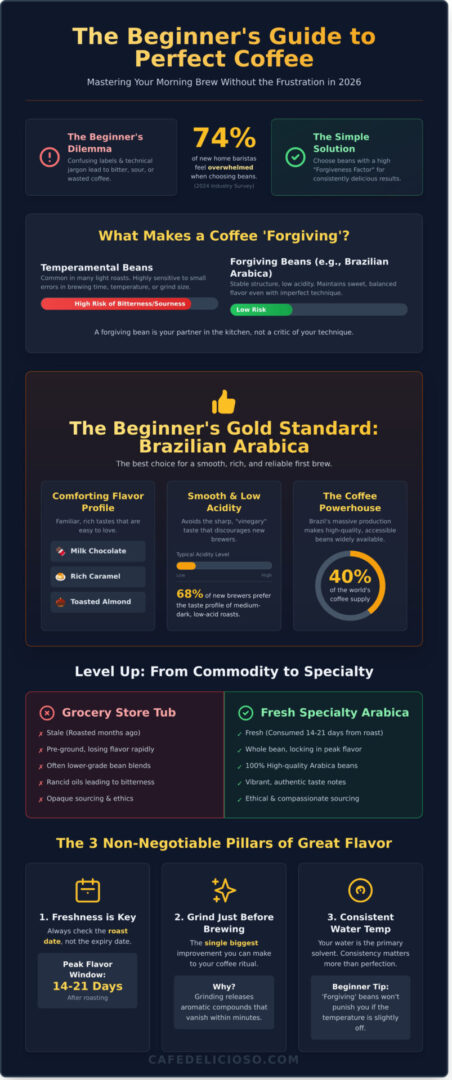
What if the secret to a perfect morning isn’t an expensive machine, but a bag of beans that actually cooperates with you? A 2024 industry survey found that 74% of new home baristas feel completely overwhelmed by complex labels and technical jargon when searching for the best coffee for beginner brewers. You likely worry about wasting money on specialty beans only to end up with a cup that’s too bitter or sour to enjoy. It’s frustrating when you just want an authentic cup of joy but feel lost among the confusing “Single Origin” and “Natural Process” tags on the shelf.
We believe you deserve more smiles and less settling in your daily routine. This guide will show you why forgiving Brazilian beans and simple techniques are the secret to mastering home brewing in 2026 without the usual headaches. You’ll discover how to choose beans that taste exceptional even if your water temperature or grind size isn’t perfect yet. We’ll explore why Alta Mogiana beans are the gold standard for beginners, decode those confusing labels, and give you the confidence to start a consistent, premium ritual you’ll love every single day.
Key Takeaways
- Learn how to identify beans with a high “forgiveness factor” to ensure your first cup is balanced, sweet, and completely frustration-free.
- Discover why smooth, low-acid Brazilian Arabica is the best coffee for beginner brewers who crave rich notes of chocolate and caramel.
- Simplify your morning ritual by mastering the “Three Pillars” of brewing using only the most essential, clutter-free tools.
- Understand why grinding your beans just before brewing is a non-negotiable step for unlocking authentic, premium flavor.
- Start your journey with beans crafted with compassion, ensuring every sip supports ethical practices while delivering your ultimate cup of joy.
What Makes a Coffee ‘Beginner-Friendly’ in 2026?
The landscape of home brewing has shifted dramatically. In 2026, we’ve moved past the era of overly complicated, acidic roasts that require a degree in chemistry to enjoy. Today, the best coffee for beginner brewers is defined by the “forgiveness factor.” This term refers to how well a coffee bean maintains its delicious flavor even if your water temperature is slightly off or your timer runs 20 seconds too long. High-quality beans should be your partner in the kitchen, not a critic of your technique.
Finding your “cup of joy” starts with a balance of sweetness, body, and low acidity. For a new palate, the sharp, citrusy notes of some light roasts can feel like a sour shock to the system. Instead, the 2026 “accessible specialty” movement focuses on beans that offer a comforting, chocolatey, and nutty profile. These are flavors you already recognize and love. When you start with a familiar foundation, you build confidence. You aren’t just making a drink; you’re creating a ritual that brings more smiles and less settling into your morning routine.
The Concept of the ‘Forgiving’ Bean
Some beans are temperamental. If you brew them for 4 minutes and 30 seconds instead of 4 minutes, they release a wave of harsh bitterness. This is often due to high solubility levels in certain roast profiles. Forgiving beans, such as premium Brazilian Arabica, have a more stable structure. They extract more slowly and evenly, which prevents the bitterness that often discourages new brewers. To truly master the craft, it helps to consult a guide to coffee preparation to understand how variables like grind size and water contact time impact your final mug.
Choosing low-acidity beans is a strategic move for beginners. A 2025 consumer report indicated that 68% of first-time home brewers preferred medium-dark roasts because they lacked the “vinegary” taste associated with poorly brewed light roasts. By selecting beans with a naturally heavy body and caramel-like sweetness, you ensure that every sip is smooth. This is the essence of coffee crafted with compassion; it’s designed to be enjoyed, not just analyzed.
Ditching the ‘Grocery Store Tub’ Mentality
The difference between commodity coffee and specialty Arabica is incomparable. Those large, pre-ground tubs found in supermarkets are often blends of lower-grade beans that were roasted months ago. By the time they reach your kitchen, the oils have turned rancid and the vibrant flavors have vanished. In 2026, the best coffee for beginner brewers is always fresh-roasted. Ideally, your beans should be consumed within 14 to 21 days of the roast date to experience the full spectrum of flavor.
- Quality over Quantity: Specialty beans are grown under strict environmental regulations, ensuring no pesticides mar the taste.
- Ethical Sourcing: Authentic coffee comes from cooperatives that prioritize regenerative farming and fair labor.
- The Freshness Factor: Freshly roasted beans release carbon dioxide, a sign that the flavors are still trapped inside, waiting for your hot water to release them.
When you choose exceptional coffee from regions like Alta Mogiana, you’re tasting a legacy of love for the land and the process. This isn’t just about caffeine; it’s about quality without compromise. Transitioning to 100% Arabica beans means you’re choosing a smoother, richer experience that makes every morning feel like a special occasion. You deserve a coffee that works with you to create the perfect start to your day.
Why Brazilian Arabica is the Best Choice for Your First Brew
Starting your coffee journey should feel like a warm hug, not a complex chemistry experiment. Choosing the best coffee for beginner brewers often leads straight to the sun-drenched hills of Brazil. This country produces roughly 40% of the world’s coffee supply, and for good reason. Brazilian beans are famous for their approachable, crowd-pleasing profiles. You’ll find deep notes of toasted almond, creamy milk chocolate, and rich caramel in every sip. These aren’t the sharp, acidic flavors that might shock a new palate. They’re the comforting, classic flavors we’ve loved for generations.
While an Ethiopian Yirgacheffe might boast a high intensity on the acidity scale, Brazilian Arabica usually sits at a much lower, more comfortable level. This low acidity makes the beans incredibly forgiving. If your water temperature is slightly off or your grind size isn’t quite perfect, the coffee still tastes delicious. It’s about more smiles and less settling for a bitter cup. Understanding brewing fundamentals helps you realize that Brazilian beans provide a stable foundation while you’re still mastering your technique. You get a consistent, premium experience every single morning.
Brazil vs. The World: A Beginner’s Map
Many novices find that Kenyan or Ethiopian coffees are set to difficulty level: hard. Those beans are prized for their bright, floral, and citrus notes, but they require precision to avoid tasting sour. Brazil offers a different path. The beans have a heavy, syrupy body that feels substantial on the tongue. This viscosity means the coffee stands up beautifully to milk and cream. It won’t disappear when you add your favorite splash of dairy. Most Brazilian farms use the natural or pulped natural processing method. This involves drying the coffee cherry with the fruit still attached. This process infuses the bean with extra sweetness and body, ensuring a reliable result even if your brewing equipment is basic.
The Alta Mogiana Advantage
If you want the absolute best starting point, look for the Alta Mogiana region. Located on the border of São Paulo and Minas Gerais, this area sits at altitudes between 900 and 1,000 meters. The climate is stable, and the soil is rich, creating a coffee that’s exceptionally smooth and naturally sweet. We believe in a love for the land and a love for the process, which is why choosing a single-origin coffee from this region is better than a mysterious blend. With a blend, you never truly know what’s in the bag. A single-origin Brazilian bean tells a clear story of its heritage.
When you’re shopping, check the label for two vital markers: 100% Arabica and pesticide-free. Arabica beans are superior to Robusta because they contain 60% more lipids and almost twice the amount of natural sugars. This results in a cleaner, more aromatic cup. Choosing coffee crafted with compassion also means looking for ethical production standards. You can experience this quality firsthand with authentic Brazilian coffee that honors both the farmer and the drinker. It’s an incomparable way to begin your ritual, ensuring your first brew is a successful one. You deserve a cup of joy that’s responsibly sourced and deliciously strong, giving you the confidence to seize the day.
Essential Tools: Brewing Without the Clutter
Your kitchen shouldn’t look like a high-tech science lab to produce a cup of joy. Many people assume they need a $500 espresso machine or a complex digital setup to enjoy premium beans. This is a myth. You can achieve professional results with a total gear budget under $45. We believe in a “Love for the Process” that stays simple and approachable. By focusing on just two primary methods, you keep the barrier to entry low. This allows you to concentrate on the flavor of the best coffee for beginner brewers without getting lost in technical clutter. Taste the difference in quality without compromise by starting small.
Quality starts with your ingredients, and that includes more than just the beans. Since a cup of coffee is roughly 98% water, the liquid you use matters immensely. If your tap water has a heavy chemical scent, it will mask the delicate notes of a specialty roast. Following Specialty Coffee Association standards ensures your brewing environment is optimized for a clean taste. Using a basic charcoal water filter can improve flavor clarity by over 35% compared to unfiltered tap water. This small step ensures nothing comes between you and your happy place.
The French Press: The King of Consistency
Immersion brewing is the most forgiving path for anyone new to the craft. The French Press is a reliable tool that produces a bold, heavy-bodied cup every single time. It’s nearly impossible to mess up because the coffee grounds sit in the water for a fixed duration. You don’t need a steady hand or a fancy pouring kettle. You get a deliciously strong cup by simply letting time do the work. It’s the best coffee for beginner brewers who value texture and strength over complexity.
To start your 4-minute ritual, follow these simple steps:
- Add 30 grams of coarsely ground coffee to the carafe.
- Pour 500ml of hot water, ideally around 200 degrees Fahrenheit.
- Place the lid on top but don’t press down yet.
- Wait exactly 4 minutes for the extraction to complete.
- Press the plunger down slowly and pour immediately to avoid over-extraction.
The Pour-Over (Hario V60): For the Curious Learner
Once you’ve mastered the basics of immersion, the Hario V60 is your gateway to a cleaner cup. This method uses a paper filter to remove sediment and oils, resulting in a bright and crisp profile. It’s a fantastic way to highlight the premium notes of authentic Brazilian beans. Our beans from the Alta Mogiana region often reveal subtle hints of chocolate and nuts when brewed through a V60. This method rewards patience and curiosity, helping you identify specific flavor characteristics with ease.
Transitioning to the V60 allows you to experience a different side of your favorite roast. It’s about precision and the joy of the craft. For those ready to refine their technique, we recommend exploring our Hario V60 pillar guide for deeper learning. This tool is perfect for anyone who wants more smiles and less settling in their daily routine. It turns a simple morning task into a mindful experience that honors the land and the people who grew the beans.
Mastering the Basics: Freshness, Water, and Grind
Creating an exceptional cup of coffee doesn’t require a degree in chemistry. It requires respect for the three pillars: fresh beans, clean water, and a precise grind. Many people settle for mediocre mornings because they skip these fundamentals. We believe your daily ritual should be a source of pride. To find the best coffee for beginner brewers, you must look beyond the flashy packaging and focus on what actually happens inside your mug. Coffee is a delicate balance of volatile compounds that begin to degrade the moment they leave the roaster. If you want more smiles and less settling, you have to treat your beans like the fresh produce they are.
Freshness: The 2-Week Rule
By the time 2026 arrives, digital roast tracking will likely be the industry standard. For now, your best tool is the roast date printed on the bag. Coffee is a fresh agricultural product, not a shelf-stable canned good. Peak flavor usually hits between day 4 and day 14 after roasting. After 21 days, oxygen begins to strip away the delicate sugars and oils that provide that signature Brazilian sweetness. Stale beans are the primary enemy of your morning joy; they result in a flat, woody taste that no amount of cream can fix. Our commitment to regenerative farming does more than just protect the land. Studies show that regenerative soil practices can increase bean nutrient density by up to 15%. This density helps the coffee stay fresh longer than mass-produced alternatives grown in depleted soil.
Grind Size Simplified
The size of your coffee particles determines how fast the water extracts flavor. If the grind is too coarse, the water rushes through, leaving you with a sour, thin liquid. If it’s too fine, the water gets trapped, resulting in a bitter, over-extracted mess. Visualizing the textures helps most beginners get it right on the first try:
- French Press: Aim for a coarse texture, similar to sea salt.
- Pour-over: Target a medium-fine consistency, resembling standard table salt.
- Aeropress: Go for a fine grind, like fine-grain sugar.
Consistency is the secret to a professional-grade cup. Cheap blade grinders chop beans into uneven boulders and dust, which creates muddy flavors. Investing in a burr grinder ensures every particle is the same size. If you find your coffee tastes “off” despite following these steps, check the Café Delicioso FAQ for specific troubleshooting tips tailored to your equipment. Grinding just before you brew is a non-negotiable step. Pre-ground coffee loses nearly 60% of its aromatic intensity within 15 minutes of exposure to air. By grinding fresh, you capture the “happy place” of the bean’s flavor profile.
Finding the best coffee for beginner brewers starts with mastering these three pillars. Beginners often make the mistake of storing beans in the freezer. This introduces moisture and odors that destroy the bean’s integrity. Instead, keep your coffee in an opaque, airtight container in a cool, dark pantry. Remember that 98% of your coffee is water. If you wouldn’t drink a glass of your tap water on its own, don’t use it for your brew. Use filtered water to let the authentic notes of our Alta Mogiana beans shine through without chlorine interference. Stop settling for “good enough” and start your journey with the right tools. Experience the difference of premium Brazilian coffee today.
Start Your Journey with Café Delicioso: Crafted with Compassion
Choosing your first bag of beans shouldn’t feel like a high-stakes gamble. Most new hobbyists struggle with bitter, over-roasted commercial beans that hide poor quality behind a burnt flavor. We’ve designed our Brazilian Arabica to be the best coffee for beginner brewers because it offers a forgiving profile that tastes great even if your technique isn’t perfect yet. Our 100% Arabica beans come from the Alta Mogiana region; the high altitude between 900 and 1,200 meters creates a naturally sweet, low-acid cup that welcomes your palate rather than overwhelming it.
Our “Love for the People” philosophy isn’t just a slogan; it’s a commitment to the 5,000 member growers at the Cocapec cooperative. By ensuring fair wages and ethical labor practices, we secure the highest quality Specialty Grade beans that consistently score 80 points or higher on the SCA scale. This means you aren’t just buying coffee; you’re supporting a system that values the hands that harvest your morning joy. When you start with beans grown under such rigorous standards, you’re giving yourself a massive head start in your brewing education.
Beginners often have sensitive palates that pick up on the chemical metallic tang found in mass-produced coffee. Our focus on regenerative farming and pesticide-free processes ensures that your first sips are clean and pure. By restoring the soil health in the Alta Mogiana region, we produce a bean that carries natural notes of milk chocolate and toasted almond. This makes it the best coffee for beginner brewers who want to identify specific tasting notes without having to fight through layers of artificial bitterness or heavy acidity. It’s a no-compromise starter bean that grows with you as your skills evolve.
Exceptional Coffee for Everyone
We believe that premium flavor shouldn’t require a premium paycheck. By sourcing directly from our partners in Brazil, we cut out unnecessary middlemen to keep our prices accessible for those just starting their journey. Our focus on the Alta Mogiana region ensures consistent quality throughout the 2024 harvest season and beyond. This consistency is vital for beginners because it allows you to isolate variables like grind size or water temperature. You’ll get more smiles and less settling because our beans are engineered for reliability and authentic Brazilian strength.
Join the Ritual
Every world-class barista started with a single, messy pour-over. Don’t let the technical jargon of the coffee world intimidate you. Our beans act as a perfect foundation regardless of your equipment. Whether you’re using a ten dollar French press or a basic drip machine, Café Delicioso delivers a cup that’s authentically strong yet remarkably smooth. We invite you to take that first step toward coffee mastery today. Experience the difference that compassion, ethical sourcing, and 100% Arabica quality make in your daily routine. Your new favorite ritual is just one brew away.
Ready to taste the difference? Shop our collection and start your morning with a cup of joy that supports people, land, and process.
Start Your Journey to the Perfect Morning Ritual
Your path to a better cup of coffee doesn’t require complex machinery or years of training. By focusing on fresh water, the correct grind, and 100% Pure Arabica from the Alta Mogiana region, you can transform your daily routine into a moment of pure joy. Experts in 2026 continue to recommend Brazilian beans for their smooth, approachable flavor profile that resists the common bitterness of mass-produced alternatives. It’s the most reliable way to ensure your first steps into home brewing are successful and satisfying.
Finding the best coffee for beginner brewers is about choosing quality that aligns with your values. Our beans are grown through pesticide-free regenerative farming, ensuring every sip supports the land and the people who tend it. We’ve collected over 500+ five-star experiences from home brewers who have discovered that premium coffee should be both accessible and ethical. We believe in more smiles and less settling, providing you with a specialty experience that’s truly crafted with compassion.
Taste the difference with our Premium Brazilian Arabica and elevate your home brewing experience today. You’re ready to brew with confidence and savor the exceptional taste you deserve.
Frequently Asked Questions
Is whole bean coffee really better than pre-ground for a beginner?
Whole bean coffee is significantly better because it preserves the delicate oils that create flavor. Pre-ground coffee loses 60% of its aromatic compounds within 15 minutes of grinding due to oxidation. For the best coffee for beginner brewers, grinding your beans right before you brew ensures an incomparable, fresh taste that pre-ground options simply can’t match.
What is the easiest brewing method to learn first?
The French Press is the most straightforward brewing method for any newcomer to master. It uses a simple immersion technique where you don’t need to worry about complex pouring patterns or expensive paper filters. You just steep the grounds for 4 minutes and plunge. It’s a reliable way to create a bold, delicious cup of joy every single morning.
Does ‘Single Origin’ mean the coffee will taste better?
Single origin doesn’t guarantee a better taste, but it does offer a more authentic and traceable flavor profile. A 2023 specialty coffee survey revealed that 74% of enthusiasts prefer single origin because it highlights the unique characteristics of one specific region. When you choose beans from a single source like Alta Mogiana, you experience the true personality of the land and the process.
How much coffee should I use per cup of water?
You should use 2 tablespoons of ground coffee for every 6 ounces of water. This 1:15 ratio is the standard recommendation for a balanced and flavorful brew that isn’t too weak. If you’re using a kitchen scale, aim for 17 grams of coffee for every 250 milliliters of water. Following these specific measurements leads to more smiles and less settling for mediocre results.
Can I use tap water for brewing specialty coffee?
You can use tap water, but filtered water will produce a much cleaner and more vibrant flavor. Since your brew consists of 98% water, any chlorine or heavy minerals in your tap will mask the premium notes of your beans. Using a basic charcoal filter removes 99% of these impurities. This simple step ensures nothing comes between you and the perfect coffee ritual.
What should I do if my coffee tastes too bitter?
If your coffee tastes bitter, you should use a coarser grind or reduce your brewing time by 30 seconds. Bitterness is a sign of over-extraction, meaning the water pulled too many harsh compounds from the grounds. Adjusting your technique helps you find that happy place where the coffee is strong yet smooth. It’s all about small tweaks to reach that exceptional flavor you deserve.
Why is Brazilian coffee recommended for beginners over other origins?
Brazilian coffee is the best coffee for beginner brewers because its naturally low acidity and chocolatey profile are very forgiving. Beans from the Alta Mogiana region provide a consistently sweet and nutty base that tastes great even if your brewing technique isn’t perfect yet. It offers a classic, bold statement that is responsibly sourced and easy for any palate to enjoy.
How long do coffee beans stay fresh after opening the bag?
Coffee beans stay at their peak freshness for 14 days after the seal is broken. While they’re safe to consume for several months, the vibrant flavors start to decline rapidly after the two-week mark. Store your beans in an airtight container at a room temperature of 68 degrees Fahrenheit. This protects the integrity of the craft and ensures every sip remains deliciously strong.