How to Make Cafe Quality Coffee at Home: The Ultimate 2026 Guide
Why does a 6 dollar latte from your local shop taste like liquid velvet while your 22 dollar bag of specialty beans produces a cup that’s thin, sour, or aggressively bitter? It’s a common struggle to find that perfect balance, and nobody likes wasting premium beans on a brew that doesn’t live up to its potential. The real secret to learning how to make cafe quality coffee at home usually lies in the 30 percent of extraction science that happens before you even press a button. You deserve a consistent, bold, and smooth experience every single morning without the guesswork that leads to pouring your coffee down the sink.
We believe that nothing should come between you and your cup of joy. This guide will help you master professional techniques and understand the sourcing secrets used by world class baristas. We’ll break down the 1 to 17 golden brewing ratio, the critical impact of 93 degree Celsius water, and how to identify authentic Brazilian Arabica. By the end of this article, you’ll have the confidence to choose the right beans and the skills to transform your kitchen into your favorite high-end cafe. It’s time for more smiles and less settling in your daily ritual.
Key Takeaways
- Understand why sourcing 100 percent pure Arabica beans from the Alta Mogiana region is the essential first step for a premium brew.
- Discover the precise golden ratio and water optimization techniques that explain how to make cafe quality coffee at home with professional consistency.
- Learn to choose between immersion and filtration methods to highlight either a heavy body or delicate flavor clarity in your daily cup.
- Master professional preparation steps including vessel preheating and filter rinsing to ensure every extraction is balanced and satisfying.
- Implement expert storage secrets and ritual building tips to protect delicate aromas and elevate your overall coffee experience.
Defining Cafe Quality: Why Your Home Brew Often Falls Short
Cafe quality coffee isn’t a happy accident. It’s the result of balancing three specific elements: extraction, clarity, and body. When you visit a specialty shop, you’re paying for a cup that tastes clean, highlights specific notes like chocolate or citrus, and feels heavy on the tongue. Most home brews fall short because they lack this balance. They often taste muddy, thin, or overwhelmingly bitter. Understanding how to make cafe quality coffee at home starts with recognizing that coffee is a volatile agricultural product, not just a shelf-stable powder. It’s about respecting the chemistry inside your mug.
Common pitfalls ruin the experience before the first sip. Stale beans are the primary culprit. Coffee peaks between 7 and 21 days after roasting. By day 30, nearly 60 percent of the delicate aromatics have evaporated, leaving a flat and woody taste. Water quality is another silent killer. Tap water with mineral content exceeding 150 parts per million (ppm) or high chlorine levels will mask the natural sweetness of the bean. Finally, incorrect water temperatures lead to failure. If your water is below 195 degrees Fahrenheit, it won’t extract the necessary sugars. If it’s above 205 degrees, it literally burns the grounds, creating a harsh, ashy flavor.
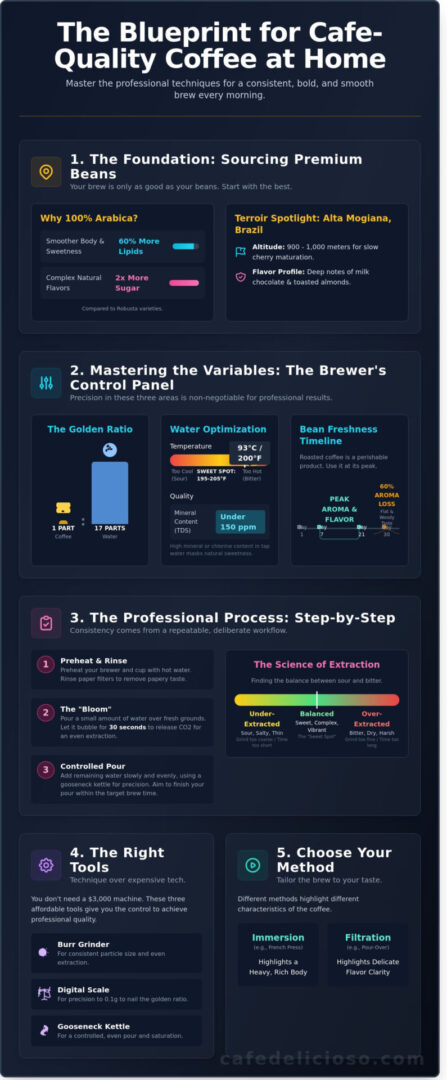
The beans you choose define your ceiling. There’s a massive gap between commodity coffee and specialty Arabica beans. At Café Delicioso, we source our beans from the Alta Mogiana region in Brazil, where they grow at altitudes above 800 meters. These beans, processed through the Cocapec cooperative, offer an authentic flavor profile that mass-produced brands can’t match. This coffee is crafted with compassion, ensuring your cup of joy is ethically produced. Our “More Smiles. Less Settling.” philosophy is built on this foundation. We believe that when you start with premium, responsibly sourced beans, you’re already halfway to a perfect cup. It’s about a “Love for the Land” and a “Love for the People” that translates directly into the chemistry of your cup.
The Science of Extraction
Extraction is the process of pulling flavor out of the coffee grounds. If your cup tastes sour, salty, or thin, it’s under-extracted. This means the water didn’t spend enough time with the coffee or the grind was too coarse. Conversely, bitter and dry notes indicate over-extraction. Professional baristas use a “dialing in” process to find the sweet spot, adjusting variables by tiny increments. Fresh beans also contain carbon dioxide, which creates the “bloom” when water first hits the grounds. This 30-second bubbling phase is essential for a comprehensive guide to coffee preparation because it clears the gas so water can reach the flavor-packed oils inside every particle.
Debunking the Expensive Machine Myth
You don’t need a three-thousand-dollar espresso machine to find your happy place. A five-dollar plastic dripper can actually produce more flavor clarity than a thousand-dollar automated brewer. High-end machines often focus on convenience over precision, whereas a manual “Love for the Process” yields superior results. To master how to make cafe quality coffee at home, you only need three essential tools: a burr grinder for consistent particle size, a digital scale accurate to 0.1 grams, and a gooseneck kettle. These tools provide the control necessary to replicate professional results without the commercial price tag. Focus on the technique, and the quality will follow.
The Foundation of Flavor: Sourcing Premium Brazilian Beans
Quality begins long before you turn on your kettle. To understand how to make cafe quality coffee at home, you must first recognize that 100 percent pure Arabica is the non-negotiable standard for any serious brewer. Arabica beans contain 60 percent more lipids and nearly twice the sugar concentration of Robusta varieties. These chemical properties result in a smoother body and a complex sweetness that eliminates the need for heavy creamers or sugars. At Café Delicioso, we believe that more smiles come from less settling, which is why we never compromise on our bean selection.
The specific terroir of the Alta Mogiana region in Brazil plays a vital role in this flavor profile. Located at altitudes between 900 and 1,000 meters, this region provides the perfect climate for slow cherry maturation. This patience results in a cup characterized by deep notes of milk chocolate and toasted almonds. When you brew these beans, you’re tasting the mineral-rich soil and the dedicated craftsmanship of the Cocapec cooperative. Following SCA’s standards for quality home brewing ensures these delicate regional notes aren’t lost to improper technique or incorrect water temperatures.
Our commitment to regenerative farming and pesticide-free growth directly impacts the cleanliness of the finish. By avoiding harsh chemicals, the natural 800 aromatic compounds within the coffee bean remain untainted. This dedication to the land produces a crisp, vibrant aftertaste that distinguishes specialty coffee from mass-produced alternatives. Single-origin Brazilian beans provide a more consistent home brew than generic blends because their uniform density and moisture levels allow for a predictable extraction every time you use your grinder.
Understanding Bean Freshness and Roast Dates
Freshness is the “Peak Flavor Window” that usually lasts about four weeks after the roast date. During the first 48 hours, beans release carbon dioxide, but after 30 days, oxygen begins to degrade the essential oils that carry flavor. Always check your label for the specific altitude and processing method. Natural processing often enhances the body, while washed processes highlight acidity. You can learn more about our premium Brazilian coffee and our specific roasting timelines to ensure you always have the freshest supply.
Ethical Sourcing as a Quality Marker
Ethical sourcing isn’t just about social responsibility; it’s a direct indicator of quality. When farmers are supported through fair labor practices, they can afford the labor-intensive process of selective picking, ensuring only the ripest cherries reach the mill. We call this being “Crafted with Compassion.” This attention to detail reduces defects in the final bag, meaning you get a more uniform and delicious cup. Discover our mission for ethical coffee and see how our love for the people translates into a better experience for you. If you’re ready to upgrade your morning ritual, consider trying our authentic Brazilian roast today.
Mastering the Variables: Grind, Water, and Temperature
You can’t leave your morning ritual to chance. If you want to know how to make cafe quality coffee at home, you have to stop guessing. It’s about mastering three specific variables: grind, water, and temperature. When these align, you get more than just caffeine; you get a cup of joy that honors the hard work of our Brazilian farmers. Precision is the bridge between a mediocre drink and an exceptional experience. At Café Delicioso, we believe in more smiles and less settling, which starts with a commitment to the details.
Professional baristas rely on the Golden Ratio to ensure every pour is balanced. We recommend a 1:16 or 1:17 coffee-to-water ratio. For a standard mug, this means using 20 grams of coffee for every 320 to 340 grams of water. Using a digital scale is non-negotiable for consistency. Eyeballing your measurements often leads to a hollow or overly sharp taste. By weighing your ingredients, you respect the process and ensure that the bold, nutty profile of our Alta Mogiana beans shines through every time.
Water quality is often overlooked, yet it makes up 98 percent of your finished cup. If your tap water has a distinct mineral or chlorine taste, it will mask the delicate notes of premium Arabica. Temperature is equally vital. Boiling water at 212 degrees Fahrenheit is the enemy of flavor; it scorches the grounds and creates a bitter, ashy aftertaste. Understanding the science of coffee brewing helps you realize that extraction is a delicate chemical dance. Keeping your water within a specific range ensures you extract sweetness rather than bitterness.
The Impact of Grind Size on Extraction
Grind size dictates how quickly water pulls flavor from the bean. A burr grinder is the single most important investment for your home cafe. Unlike blade grinders that chop beans into uneven shards, burrs produce uniform particles for even extraction. For a French Press, your grind should look like coarse sea salt. If you’re brewing a pourover, aim for a texture similar to table salt. If the water flows too fast, your coffee will taste sour; if it’s too slow, it becomes bitter and dry. Visual cues are your best friend here.
Water Chemistry for Coffee Lovers
Hard water is a common hurdle when learning how to make cafe quality coffee at home. High levels of calcium and magnesium can mute the bright, authentic notes of Brazilian specialty coffee. To achieve cafe-level clarity, use filtered water or third-wave water packets that add a precise mineral balance back into distilled water. Your brewing temperature should stay between 195 and 205 degrees Fahrenheit. This range is the sweet spot for dissolving the desirable oils and sugars in the bean without over-extracting the harsh tannins. It’s a simple change that leads to an incomparable flavor profile.
Step by Step Guide to Professional Home Brewing Methods
Professional results require a shift in mindset from simply making coffee to executing a precise recipe. Understanding how to make cafe quality coffee at home begins with selecting a brewing method that aligns with your sensory preferences. If you love a full-bodied, robust cup that coats the tongue, the French Press is your ideal companion. If you prefer a clean, tea-like consistency that highlights subtle acidity and sweetness, a pourover is the superior choice. Regardless of the method, preparation is the foundation of excellence. You must preheat your brewing vessel with water heated to exactly 200 degrees Fahrenheit to maintain thermal stability throughout the extraction. Rinsing your paper filters with hot water is equally vital; this simple step removes dry cellulose flavors that often interfere with the authentic, nutty profile of our Brazilian beans. A digital scale is the most important tool in your kitchen because it replaces vague measurements like scoops with precise grams. Using a 1:16 coffee-to-water ratio provides a consistent baseline for every brew, ensuring your cup of joy tastes exactly the same every single morning. Applying these professional techniques is the most effective way to learn how to make cafe quality coffee at home without needing expensive commercial machinery.
The bloom phase occurs when you saturate the grounds with twice their weight in water for 30 seconds, allowing trapped carbon dioxide to escape so the water can fully extract the rich chocolate and hazelnut oils characteristic of fresh Brazilian beans.
The Perfect French Press Technique
First, use a coarse grind resembling sea salt and steep for exactly four minutes to achieve maximum richness. After the timer ends, use a spoon to break the surface crust and scoop away the floating foam; this break and clean method ensures a silky, sediment-free mouthfeel. Finally, decant the coffee into a carafe immediately after pressing to prevent over-extraction and the bitterness that ruins a perfect cup.
Mastering the Pourover for Flavor Clarity
Start with a gentle, circular pour moving from the center outward to ensure every ground is evenly saturated. Maintain a steady, slow flow rate to control the contact time and prevent the brew from becoming weak. Observe the final draw down time; if it exceeds 3 minutes and 45 seconds, your grind is likely too fine. This visual diagnosis is essential for perfecting your technique over time.
Great coffee is a journey of constant refinement and love for the process. When you take the time to measure your ingredients and monitor your temperatures, you aren’t just making a drink; you’re honoring the hard work of the farmers in the Alta Mogiana region. These small adjustments in your kitchen lead to a significantly better experience, providing you with the energy and happiness needed to seize the day. Consistency is the hallmark of a true barista, and by following these steps, you bring that expertise into your own home. More smiles and less settling are only a few grams and degrees away.
Experience the bold flavors of Brazil in your own kitchen and buy premium Brazilian coffee to start your professional brewing journey today.
Building Your Daily Ritual: More Smiles and Less Settling
Your morning coffee is more than a caffeine delivery system. It is a moment of peace before the world starts demanding your attention. When you master how to make cafe quality coffee at home, you stop settling for mediocre brews and start every day with a genuine win. This transformation begins with how you treat your ingredients and the space where you create.
To protect the delicate oils and chocolatey aromas of your Alta Mogiana beans, storage is your first priority. These beans are prized for their natural sweetness, but oxygen is their primary enemy. Store your coffee in an opaque, airtight container at a consistent temperature of 21 degrees Celsius. Avoid the refrigerator or freezer. Moisture fluctuations in those environments can damage the cellular structure of the bean, leading to a flat and lifeless cup. By keeping your beans in a cool, dark pantry, you ensure that every extraction releases the full potential of the Brazilian soil.
Setting the stage for your ritual is just as vital as the beans themselves. Dedicating a specific corner of your kitchen to coffee creates a powerful psychological anchor. Research from the University of Toronto suggests that even environmental cues associated with coffee can increase mental alertness and focus. When you see your scale, grinder, and favorite ceramic mug arranged neatly, your brain begins to relax and prepare for the day. This small sanctuary becomes a place where you prioritize your own joy.
The financial benefits of this ritual are also substantial. In 2024, the average price of a specialty cafe latte has risen to roughly $5.50. In contrast, brewing a premium 12-ounce cup at home using high-quality Brazilian beans costs approximately $0.62. For a daily coffee drinker, this shift represents a total annual saving of $1,781.20. You aren’t just saving money; you are reinvesting that capital into a higher quality of life and better ingredients. Don’t be afraid to experiment with your ratios or water temperatures. Finding the unique flavor profile that makes you smile is the ultimate goal of the home barista.
Troubleshooting Your Brew
If your coffee tastes thin or watery, your grind size is likely too coarse, or your coffee-to-water ratio is too low. Try a finer setting to slow down the water flow. If the taste is unpleasantly sharp or acidic, the coffee is under-extracted. You can fix this by using slightly hotter water or increasing your brew time. For a deeper look at perfecting your technique, check our FAQ for more coffee brewing tips to solve common extraction issues.
The Café Delicioso Difference
Starting your journey with a bold Brazilian bean makes the learning curve much easier because our beans offer a consistent, forgiving flavor profile. We believe in “Love for the People” in every bag, ensuring that our farmers in the Alta Mogiana region are supported through ethical practices. This commitment to quality and compassion means you get an incomparable cup every single time. To start your journey, shop our fresh roasted Brazilian beans and taste the difference that authentic specialty coffee makes.
Elevate Your Daily Brew Starting Tomorrow
You now have the blueprint to transform your kitchen into a high-end espresso bar. Success depends on mastering variables like the 200 degree Fahrenheit water temperature and using the precise grind setting for your specific brewer. Most importantly, the foundation of every great cup is the bean itself. By choosing 100% Pure Arabica from the Alta Mogiana region, you ensure every sip is free from pesticides and grown through regenerative farming practices that protect the earth.
Learning how to make cafe quality coffee at home isn’t just about technique; it’s about the ethical journey from the Cocapec cooperative to your mug. This commitment to quality means you can enjoy a morning ritual that brings more smiles and less settling. You’ve seen how professional methods and specialty sourcing can bridge the gap between a basic caffeine fix and a true sensory experience. Don’t let another day pass with a mediocre brew when authentic Brazilian excellence is within reach. Experience the bold taste of premium Brazilian coffee today and start every morning with your own personal cup of joy.
Frequently Asked Questions
Why does my home coffee always taste bitter compared to a cafe?
Bitter coffee is usually the result of over-extraction caused by water that’s too hot or a grind that’s too fine. Most cafes brew at a precise temperature between 195 and 205 degrees Fahrenheit; if your home machine exceeds this, it scalds the grounds. When you use a grind that’s too small for your brewer, the water stays in contact with the coffee for too long, pulling out harsh tannins instead of sweet oils.
Is it better to buy whole bean or pre ground coffee for cafe quality?
Buying whole bean coffee is the most effective way to learn how to make cafe quality coffee at home because it preserves freshness. Coffee beans lose approximately 60 percent of their aromatic compounds within just 15 minutes of being ground. By grinding your beans immediately before brewing, you ensure those vibrant flavors end up in your cup of joy rather than evaporating into the air of your kitchen.
What is the best water to coffee ratio for a strong cup?
A 1 to 15 ratio is the gold standard for brewing a robust and specialty-grade cup of coffee. This specific measurement means you should use 20 grams of coffee for every 300 grams of water. Following this precise formula ensures you don’t end up with a watery or weak beverage. It’s a simple step that leads to more smiles and less settling for mediocre mornings.
Do I really need a special kettle to make good coffee at home?
You don’t need a special kettle for immersion methods like the French Press, but a gooseneck kettle is essential for pour-overs. These kettles allow you to control the flow rate to a steady 3 to 5 grams of water per second. This level of precision prevents channeling, where water bypasses the grounds; instead, it ensures every particle is saturated evenly for a balanced, professional flavor profile.
How can I tell if my coffee beans are actually fresh?
Fresh coffee beans will always feature a specific roast date on the bag instead of a generic expiration date. You can test freshness by placing a few beans in a zip-top bag and squeezing the air out; if the bag puffs up after 24 hours, the beans are still degassing healthy carbon dioxide. When brewing, look for the bloom, which is the bubbly foam that appears as hot water hits fresh grounds.
What makes Brazilian coffee different from other origins for home brewing?
Brazilian coffee from the Alta Mogiana region is prized for its naturally low acidity and rich, nutty body. While beans from Ethiopia often have 10 percent higher citric acidity, our Brazilian Arabica focuses on smooth chocolate and caramel notes. This profile is much more forgiving for home brewers because it maintains a creamy texture and sweetness even if your brewing temperature or timing fluctuates slightly.
Can I achieve cafe quality coffee with a standard drip machine?
You can achieve professional results with a drip machine if you choose a model that’s SCA certified to reach 195 degrees Fahrenheit. Many standard machines only reach 180 degrees, which fails to extract the complex sugars within the bean. Learning how to make cafe quality coffee at home with a drip brewer also involves using a reusable gold-tone filter to allow natural oils into your mug for a richer mouthfeel.
How should I store my coffee beans to keep them fresh for longer?
Store your coffee beans in an airtight, opaque container kept in a cool, dark cupboard away from the stove. Exposure to oxygen and light can stale your beans 50 percent faster than protected storage. You should never store your coffee in the freezer; the moisture from constant temperature fluctuations damages the bean’s cell structure and mutes the incomparable flavors we work so hard to source from our Brazilian farms.