
Avoiding Bitterness in Coffee: A Guide to the Perfect Smooth Cup
Bitterness is not an inherent trait of a bold roast; it is an extraction error that masks the true character of your beans. You might feel forced to hide harsh flavors under layers of cream and sugar, especially after spending an average of $22.40 on a bag of specialty coffee. It is discouraging when your morning ritual feels like a gamble rather than a guaranteed moment of peace. With 66% of American adults drinking coffee every single day, you deserve a result that brings a smile to your face without the need for additives.
By focusing on avoiding bitterness in coffee through precise, scientific adjustments, you can consistently brew a smooth and naturally sweet cup at home. We will show you how to master the variables within your control to achieve professional results every morning. This guide explains how to apply the Specialty Coffee Association Golden Cup standards, including maintaining water temperatures between 92°C and 96°C, to ensure every sip is a genuine cup of joy that reflects the exceptional quality of authentic Brazilian beans.
Key Takeaways
- Learn to manage the extraction sequence by adjusting your grind size and water temperature for better balance.
- Discover why selecting 100 percent Arabica beans is a vital step in avoiding bitterness in coffee.
- Identify how specific roast levels and bean origins like Alta Mogiana create a naturally sweet flavor profile.
- Understand the impact of water hardness and equipment cleanliness on the final clarity of your brew.
- Apply professional brewing standards to ensure every cup you make at home is consistently smooth and satisfying.
Understanding the Science of Bitter Coffee Extraction
Bitterness is not a flavor profile you have to accept. It is a sign that something went wrong during the brewing process. When you taste that harsh, tongue-drying sensation, you are actually tasting dissolved plant fibers and heavy organic compounds. These materials are meant to stay inside the coffee grounds, but they leak out when the balance of your brew is off. Understanding this physical process is the first step toward a better morning ritual.
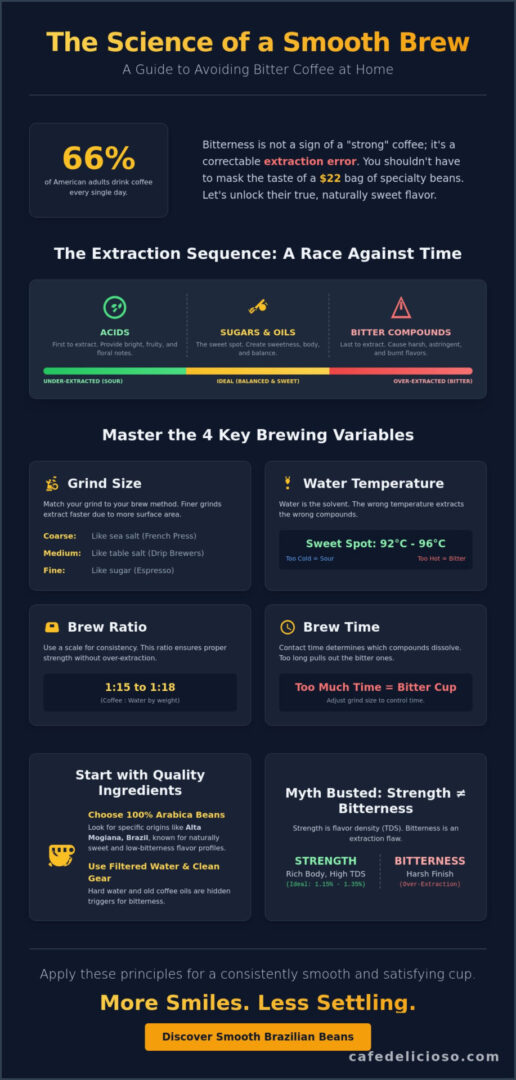
To fix your brew, you must understand the extraction sequence. Extraction is a race against time. The very first things water pulls from the beans are fruity acids. These provide the sparkle and life in your cup. Immediately after, the water extracts the sugars and oils that create sweetness and body. The bitter compounds are the slowest to dissolve. This means bitterness is usually the last thing to enter your cup. If your coffee tastes like burnt toast, it is likely because the water stayed in contact with the beans for too long.
There is a clear line between pleasant acidity and unpleasant bitterness. Acidity feels bright and clean, like a squeeze of lemon in tea. Bitterness feels heavy and dirty. It coats the tongue and refuses to leave. Calibrating your palate to identify this difference allows you to stop your brew before it crosses the line into over-extraction. This is the foundation of avoiding bitterness in coffee.
The Chemistry of the Brew
Water is much more than just a liquid; it is a solvent that pulls flavors from the coffee’s cellular structure. When hot water hits your grounds, it causes the bean’s cells to swell and eventually break down. This is why temperature is so critical. If your water exceeds the SCA standard of 96°C, it becomes too aggressive. It begins to dissolve polyphenols and other harsh chemicals that are naturally present in the wood-like structure of the coffee bean. By studying the science of coffee extraction, we can see that precision is the only way to protect the delicate sugars we love and ensure your cup of joy stays sweet.
Why Strength is Not the Same as Bitterness
Many people mistakenly believe that strong coffee must be bitter. This is a myth that prevents many from enjoying a truly bold cup. Strength is simply the measurement of Total Dissolved Solids (TDS) in your water. According to 2026 research, the ideal TDS for a smooth cup is between 1.15% and 1.35%. You can achieve a high TDS and a rich, heavy body without ever touching the bitter compounds. The key is using the right ratio of coffee to water, typically 1:15 to 1:18, rather than just brewing for a longer time. This allows you to experience the deep, chocolatey notes of our Brazilian specialty beans without any of the harshness. True strength is about flavor density, not extraction errors. Avoiding bitterness in coffee means finding that perfect balance where the body is heavy but the finish is clean. More Smiles. Less Settling.
Mastering the Brewing Variables: Grind, Time, and Temperature
Precision is the ultimate antidote to a bad cup. Many people reach for salt or cream to mask a harsh aftertaste, but these are just bandages for a broken brewing process. True mastery comes from controlling your variables before the first drop hits the mug. To achieve professional results at home, you must treat your kitchen like a laboratory. Consistency is the only way to guarantee that your morning ritual remains a cup of joy rather than a bitter disappointment. Use this checklist for every brew cycle:
- Weigh your ingredients: Use a digital scale to maintain a strict 1:15 to 1:18 coffee-to-water ratio.
- Match the grind to the method: Surface area dictates extraction speed.
- Calibrate your water: Temperature determines which compounds dissolve.
- Track the clock: Contact time is the difference between sweetness and ash.
The relationship between surface area and extraction speed is the most important concept in avoiding bitterness in coffee. Smaller particles have more surface area exposed to water, which means they give up their flavors much faster. If your grind is too fine for your brewing time, the water will move past the sugars and start dissolving the heavy, bitter fibers of the bean. Mastering this balance is the secret to More Smiles. Less Settling.
Adjusting Your Grind Size
A grind that is too fine creates a muddy, silt-heavy cup. For immersion methods like the French press, your grounds should look like coarse sea salt. Standard drip brewers require a medium grind similar to table salt. Be wary of “fines,” which are microscopic dust particles often produced by low-quality blade grinders. These tiny particles over-extract almost instantly, causing a sharp bitterness even if the rest of your grounds are the correct size. Using a burr grinder is a foundational step in avoiding bitterness in coffee.
Controlling Water Temperature
Stop using water straight from a rolling boil. While some online communities suggest 212 degrees Fahrenheit, this extreme heat scorches the delicate oils in specialty beans. The ideal range is between 195 and 205 degrees Fahrenheit. If you do not have a thermometer, simply let your kettle rest for 60 seconds after it finishes boiling. This brief pause allows the temperature to drop into the safe zone, protecting the natural sweetness of the beans.
Timing the Extraction
Every brewing method has a specific “sweet spot” for contact time. A French press typically requires four minutes of steeping; leaving the plunger down for ten minutes will result in a dry, astringent finish. For manual methods, timing is even more critical. You can follow our Hario V60 guide to learn how to hit a perfect three-minute pour. Once you master these timing cues, you will finally taste the smooth, nutty profile of our freshly roasted Brazilian coffee without any interference from bitter extraction errors.
Why the Quality and Roast of Your Coffee Beans Matter
Even the most precise brewing technique cannot salvage a low-quality bean. If you start with a product that is genetically predisposed to harshness, your efforts in avoiding bitterness in coffee will always fall short. The foundation of a smooth cup begins with selecting the right species and understanding how the roasting process alters its chemical makeup. High-quality coffee is an investment in your daily happiness, and understanding what is inside your bag is the first step toward a better experience.
The coffee world is primarily divided between two species: Arabica and Robusta. Robusta beans are often found in mass-produced blends because they are hardy and cheap to produce. However, they contain roughly 2.7% caffeine, which is nearly double the amount found in Arabica. Caffeine is a naturally bitter alkaloid; therefore, Robusta will always have a more rubbery and astringent finish. Choosing 100 percent Arabica is the most important decision for any coffee lover who values sweetness over bite.
The Arabica Advantage
Arabica beans are the gold standard for specialty coffee. They thrive at higher altitudes where cooler temperatures slow down the maturation of the coffee cherry. This extra time allows the plant to develop a higher concentration of natural sugars and organic acids. When these beans are sourced from renowned regions like Alta Mogiana, they carry a signature profile of chocolate and nuts rather than ash. You can explore these regional differences in detail through our Brazilian coffee guide. By focusing on single-origin Arabica, you ensure that the flavor clarity remains high and the bitterness remains low. It is about choosing quality without compromise.
Roast Levels and Flavor Perception
Roasting is a delicate dance between heat and time. As beans reach a medium roast, the natural sugars caramelize, creating the “cup of joy” we all crave. However, if the roast continues into the dark territory, the beans experience a physical event called the second crack. At this stage, the cellular structure collapses and the internal oils migrate to the surface and carbonize. This carbonization is the primary cause of the “burnt” bitterness found in many commercial coffees. Avoiding bitterness in coffee is much easier when you stick to medium roasts that preserve the bean’s integrity. Look for labels that mention low-acid or smooth profiles to ensure you are getting a bean treated with care during the roasting process.
Our commitment to regenerative farming is not just about ethics; it is about flavor. Pesticide-free soil produces a cleaner bean with fewer off-flavors. When plants grow in a healthy, balanced ecosystem, they produce more complex fruit. This leads to a naturally smoother finish that requires no cream or sugar to enjoy. More Smiles. Less Settling. By choosing beans grown with a love for the land, you are supporting a process that prioritizes taste and sustainability in every sip.
Maintenance and Water: The Often Overlooked Bitterness Triggers
Even if you follow every brewing rule, your efforts in avoiding bitterness in coffee can be sabotaged by a dirty machine. Coffee beans are rich in oils that provide body and aroma, but these oils are highly unstable. Once they are exposed to heat and oxygen, they begin to oxidize and turn rancid. These old, sticky residues cling to your filter basket and carafe, tainting every fresh batch with a sharp, metallic bitterness. If your morning cup tastes like a stale memory, it is time to look at your equipment maintenance. A clean machine is the only way to ensure the nutty and chocolatey notes of our beans shine through.
Your water choice is just as critical as the beans themselves. Since a standard cup of coffee is approximately 98% water, any impurities in your tap will be magnified in the final brew. Chlorine, which is used in many municipal water systems to ensure safety, reacts negatively with coffee compounds to create a medicinal, chemical bitterness. Furthermore, the mineral balance in your water acts as a set of claws that pull flavors out of the grounds. If your water is too “hard,” it can be too aggressive, leading to over-extraction and a harsh finish.
Cleaning Your Brewing Equipment
Rancid oils are a primary source of “off” flavors that many people mistake for poor roasting. You should wash your carafe and filter basket with mild, fragrance-free soap after every single use. Burr grinders also require regular attention. Old coffee dust and oils build up on the burrs, eventually turning rancid and ruining the clarity of your next batch. We recommend deep cleaning your grinder at least once a month. Additionally, descaling your brewer every 90 days prevents limescale buildup. Scale acts as an insulator, preventing your machine from reaching the 195 to 205 degree Fahrenheit range required for a balanced extraction. This is a vital part of our Love for the Process.
The Role of Water Quality
Finding the right water balance is a delicate task. You should never use distilled water; it lacks the minerals necessary to pull flavor from the beans, resulting in a flat and sour cup. Conversely, very hard tap water contains high levels of calcium and magnesium that can over-extract bitter compounds. A simple carbon-based water filter can provide a significant improvement in cup clarity by removing chlorine and sediment. Using filtered water provides a neutral canvas that allows the authentic Brazilian flavors to take center stage. Once your equipment is spotless and your water is pure, you are ready to shop our fresh roasted Brazilian beans and experience the difference that quality makes. More Smiles. Less Settling.
Choosing Smoothness: The Café Delicioso Approach to Low-Bitterness Coffee
The journey toward a perfect cup ends where the beans begin. While mastering your grind and water temperature is essential, the inherent quality of the bean sets the ceiling for your success. At Café Delicioso, we focus our efforts on the Alta Mogiana region of Brazil. This specific area is world-renowned for producing coffee with a naturally low acidity and a heavy, creamy body. By sourcing from this high-altitude plateau, we provide a foundation that makes avoiding bitterness in coffee an effortless part of your morning routine. You don’t have to fight against your ingredients when the beans themselves are designed for smoothness.
Our selection process is rigorous and intentional. We exclusively use 100 percent Arabica beans, specifically chosen for their deep nutty and chocolatey profiles. Unlike mass-market blends that rely on harsh fillers, our coffee celebrates the authentic sweetness of the Brazilian landscape. This flavor clarity is a direct result of our commitment to regenerative farming. We believe that healthy soil produces a superior fruit. By ensuring our beans are grown without pesticides and in harmony with the environment, we deliver a cleaner taste that reflects our Love for the Land.
Crafted with Compassion and Quality
Our “Love for the Process” is more than a slogan; it is a promise of quality. We understand that freshness is the enemy of bitterness. When coffee sits on a grocery store shelf for months, the oils turn stale and the flavor profile collapses into a one-dimensional bitterness. To prevent this, we utilize a direct-to-consumer model. This ensures that your coffee is roasted and shipped with maximum efficiency, arriving at your door at the peak of its flavor. You can explore our specific flavor profiles and learn more about our sourcing on our coffee page. Experience the difference that ethical production and specialty standards bring to your cup of joy.
Your Journey to a Better Cup
Bitterness is a choice, not a requirement. By applying the scientific brewing steps we have discussed and starting with premium Brazilian beans, you can reclaim your morning ritual. Avoiding bitterness in coffee is simply a matter of respecting the bean and controlling the variables. If you ever run into trouble with your brew, we invite you to check our FAQ for detailed troubleshooting tips and guidance. We are here to ensure you never have to settle for a mediocre cup again. Taste the difference in quality without compromise. More Smiles. Less Settling. Stop settling for harsh flavors and start your day with a coffee that is crafted with compassion and designed for pure satisfaction.
Elevate Your Daily Coffee Ritual
You now have the tools to transform your morning. By managing the science of extraction and keeping your equipment spotless, you’ve mastered the technical side of avoiding bitterness in coffee. Success comes from the balance of precise brewing and the inherent quality of your beans. You no longer need to hide your coffee behind creamers or settle for a harsh finish.
We invite you to Shop Café Delicioso and experience naturally smooth Brazilian coffee. Our 100% Pure Arabica beans from the Alta Mogiana region are selected for their deep, chocolatey sweetness. Because we prioritize regenerative farming and pesticide-free growth, every bag delivers a clean and authentic taste. Experience premium specialty coffee that is ethically sourced and affordable for every home brewer.
Your journey to a perfect cup is just beginning. With these practical steps and exceptional beans, you’ll find your happy place in every mug. Enjoy the clarity and comfort of a truly smooth brew. More Smiles. Less Settling.
Frequently Asked Questions
Why does my coffee taste bitter even with expensive beans?
Expensive beans are only half of the equation for a perfect cup. If your grind is too fine or your water is too hot, you will still pull out the bitter plant fibers regardless of the bean’s price. Even a bag of specialty coffee can taste burnt if the water contact time is too long. Check your brewing variables to ensure you aren’t over-extracting the delicate sugars that make specialty coffee so rewarding.
Can I use salt to make my coffee less bitter?
Yes, a tiny pinch of salt can suppress your tongue’s ability to perceive bitterness. However, this is a temporary fix that masks flavor rather than improving the quality of your brew. We recommend focusing on avoiding bitterness in coffee through better technique and fresh beans. Salt might hide the bite, but it won’t reveal the true nutty and chocolatey notes of a high-quality Brazilian bean.
What is the best water temperature for avoiding bitterness in coffee?
The ideal temperature range for a balanced extraction is between 195 and 205 degrees Fahrenheit. According to 2026 SCA standards, water above 205 degrees is too aggressive and will scorch the grounds. If you don’t have a thermometer, let your kettle sit for 60 seconds after boiling to reach this safe zone. This simple pause protects the natural sweetness and prevents a harsh, ashy finish in your cup of joy.
Does the type of coffee filter affect the bitterness of the brew?
Yes, paper filters produce a cleaner cup by trapping fine particles and bitter-tasting oils. Metal filters allow more oils and “fines” to pass through, which creates a heavier body but can increase the perception of bitterness. If you prefer a very smooth and crisp finish, a high-quality paper filter is your best choice for a clear and bright morning ritual. It is all about finding the balance that brings you more smiles.
Is dark roast coffee always more bitter than light roast?
Dark roasts are naturally more prone to bitterness because the beans undergo carbonization during the roasting process. When beans reach the “second crack” stage, their cellular structure breaks down and oils burn on the surface. While some enjoy the smoky profile, those seeking a smooth experience should choose a medium roast. This preserves the bean’s natural sugars without the burnt aftertaste that leads to settling for a mediocre cup.
How do I know if my coffee is bitter or just strong?
Strength refers to the concentration of dissolved coffee solids, while bitterness is an unpleasant flavor defect. A strong cup should feel heavy and rich on the tongue without being harsh. Bitterness leaves a dry, astringent sensation in the back of your throat that lingers long after your sip. If your coffee is intensely flavored but finishes clean, it is simply strong. If it leaves an unpleasant bite, it is over-extracted.
Can an old coffee grinder cause bitterness in my cup?
An unmaintained or dull grinder is a common cause of unexpected bitterness. Over time, burrs become dull and produce “fines,” which are tiny dust particles that over-extract almost instantly. Additionally, old coffee oils build up inside the machine and turn rancid. Regular cleaning and replacing worn burrs ensure a consistent grind size. This consistency is essential for avoiding bitterness in coffee and maintaining the integrity of your favorite ritual.
What should I do if my coffee is already bitter after brewing?
If your cup is already brewed and tastes harsh, you can try adding a small amount of hot water to dilute the intensity. While this won’t remove the bitter compounds, it can make the flavor profile more approachable. For a better experience tomorrow, try adjusting your grind to be slightly coarser or decrease your brew time by 30 seconds. Don’t settle for a bad cup; use it as a guide to calibrate your next perfect brew.