7 Essential Signs of High Quality Coffee: A Guide for Connoisseurs
The most expensive bag on the shelf is often the biggest waste of your money. It’s incredibly frustrating to spend twenty dollars on a bag with beautiful gold foil only to find oily, stale beans that taste like burnt toast. You deserve a cup of joy every morning, not a bitter reminder of wasted potential. Most coffee drinkers struggle with inconsistent brewing results because they don’t know which visual cues to look for. Identifying the true signs of high quality coffee is a skill that saves you money and elevates your daily ritual from mundane to exceptional.
We believe that premium coffee should be crafted with compassion for the people and the land. You’ll learn how to identify authentic specialty beans by looking for transparency in labeling, such as specific harvest dates and farm locations like the Alta Mogiana region in Brazil. This guide explains how ethical sourcing and pesticide-free farming directly impact the flavor in your mug. We’ll show you how to navigate certifications and visual bean inspections so you can confidently select beans that meet the highest standards of quality and integrity.
Key Takeaways
- Learn to decode packaging by identifying the 100 percent Arabica gold standard and prioritizing a recent roast date for peak freshness.
- Master the art of visual inspection to spot the signs of high quality coffee by looking for consistent bean size and the absence of physical defects.
- Discover how transparent sourcing and regional partnerships like the Cocapec cooperative ensure superior bean density and flavor.
- Understand the link between ethical farming and taste, including how regenerative agriculture and pesticide-free cultivation produce a cleaner cup.
- Refine your palate by learning to distinguish complex aroma notes and bright acidity from the flat bitterness of mass-produced beans.
Decoding the Label: What High Quality Coffee Packaging Reveals
Your morning ritual deserves more than a generic bag from a grocery shelf. When you look at a label, you are looking for a roadmap to flavor. One of the primary signs of high quality coffee is a commitment to transparency that goes beyond marketing buzzwords. A bag that tells you exactly where, when, and how the beans were processed is a bag that respects the consumer and the craft. At Café Delicioso, we believe that nothing should come between you and your cup of joy, and that starts with knowing what is inside your bag.
The 100 Percent Arabica Distinction
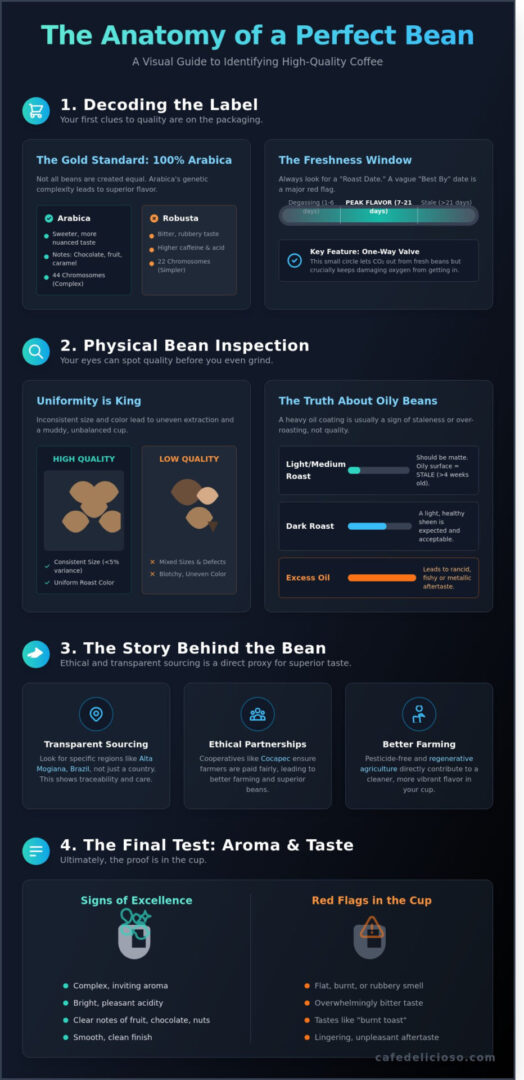
Arabica beans are the gold standard for a reason. They possess a complex genetic structure with 44 chromosomes, which is double the count found in the hardier Robusta bean. This biological complexity translates into a sweeter, more nuanced experience. While Robusta often tastes bitter or rubbery due to higher caffeine and chlorogenic acid content, Arabica offers the rich notes of chocolate, caramel, and fruit found in premium Brazilian coffee. True quality often involves Specialty Class 1 grading. This rigorous standard, set by the Specialty Coffee Association, ensures the beans have zero primary defects and fewer than five full defects per 300 gram sample, resulting in an incomparable taste.
Freshness and the Roast Date Window
Freshness isn’t a suggestion; it’s a requirement for any connoisseur. High quality roasters always print a specific roast date rather than a vague expiration date that could be 12 months in the future. Coffee reaches its peak flavor profile between 7 and 21 days after roasting. If a bag lacks a roast date, it’s a major red flag that the beans are likely stale. You can verify recent roasting by checking for CO2 release. Freshly roasted beans emit gas that causes the bag to feel slightly pressurized. You’ll also see this gas at work when you brew; fresh grounds will “bloom” or bubble when they first hit the water.
To preserve these delicate flavors, look for packaging with a one-way valve. These small circular vents are essential because they allow carbon dioxide to escape without letting oxygen enter the bag. Oxygen is the enemy of quality. It causes the natural oils in the beans to oxidize and turn rancid, stripping away the signs of high quality coffee you expect. Beyond the valve, look for single origin details. Moving beyond country-level labeling to specific regions like Alta Mogiana in Brazil shows a dedication to the land and the process. This transparency ensures you are supporting ethical production and receiving a product that truly represents its unique terroir. It’s about more smiles and less settling in every single pour.
Physical Indicators: How to Inspect Your Coffee Beans Like a Pro
Your eyes are the first line of defense against a mediocre cup. Before water ever touches the grounds, the physical state of the beans tells a story of either meticulous care or industrial neglect. One of the most reliable signs of high quality coffee is a batch that looks intentional rather than accidental. When you pour a handful of beans into your palm, you’re looking for the results of precise agricultural standards and roasting expertise.
Visual Consistency and Roast Precision
Professional roasting requires total mastery over the Maillard reaction; the complex chemical process that transforms green seeds into aromatic brown beans. When you inspect a bag of premium Arabica, every bean should share a nearly identical shade. Inconsistency suggests a roaster struggled with heat control or used a blend of cheap fillers to bulk up the volume. Size uniformity is equally vital. If a bag contains a mix of tiny seeds and large Screen 18 beans, they’ll extract at different rates in your brewer. This results in a muddy flavor where some grounds are over-extracted and bitter while others remain sour and under-developed. High quality specialty coffee typically maintains less than a 5 percent variance in bean size to ensure a balanced extraction.
The Truth About Oily Beans
There’s a common misconception that shiny, oily beans are a universal indicator of freshness. It’s actually more complicated. Oil is a byproduct of the roasting process where heat breaks down the bean’s internal cellular structure, pushing lipids to the surface. For a dark roast, a light sheen is expected and healthy. However, if a medium or light roast looks drenched in oil, it likely suffered from excessive heat or has been sitting on a shelf for more than four weeks. Over time, these surface oils oxidize and turn rancid, creating a fishy or metallic aftertaste. You should look for a healthy, matte finish on lighter roasts and a gentle, satin glow for darker profiles. Avoid beans that look gray, dusty, or bone-dry, as they’ve likely lost their vital flavor compounds.
Beyond color and oil, you must look for physical defects that lower the grade of the coffee. The Specialty Coffee Association (SCA) allows zero Category 1 primary defects, such as mold or black beans, in a 350-gram sample of specialty grade coffee. You can spot lower quality batches by looking for:
- Quakers: These are pale, shriveled beans that didn’t ripen properly on the branch. They don’t brown during the roast and taste like toasted paper or dry popcorn.
- Shells: These thin, fragile fragments burn easily and create a charred, ashy flavor in the cup.
- Insect Damage: Small, visible holes indicate the coffee cherry was compromised before harvest, often leading to sour or fermented “off” notes.
Finally, trust the intensity of the dry fragrance. A high quality bean should release a powerful, complex aroma the moment you open the bag. This intensity signals a high concentration of volatile oils that haven’t yet dissipated into the atmosphere. If you want to see what professional sorting and roast precision look like in practice, you can explore our authentic Brazilian beans that are crafted to meet these exact standards. Real quality isn’t just felt in the flavor; it’s visible in every single bean.
The Importance of Transparency: Why Sourcing Matters for Quality
Transparency isn’t just a buzzword in the specialty world. It’s a roadmap to flavor. One of the clearest signs of high quality coffee is a roaster’s ability to tell you exactly where your beans grew. When we know the farm, the altitude, and the soil health, we can predict the character of the cup before the first sip. This level of detail ensures you aren’t just buying a generic commodity; you’re buying a specific harvest crafted with intention.
Terroir plays a massive role in bean development. At altitudes above 900 meters, coffee cherries mature slowly. This patience results in a denser bean packed with concentrated sugars and complex organic acids. High-density beans are a hallmark of excellence because they withstand the roasting process better, allowing for a more nuanced and vibrant flavor profile. When you look for signs of high quality coffee, start with the label. If it lists a specific farm or lot, you’re likely holding a superior product.
The Alta Mogiana Advantage
The Alta Mogiana region in Brazil sits at an ideal elevation between 900 and 1,000 meters. This unique plateau provides consistent rainfall and rich, mineral-heavy soil that coffee trees love. These specific environmental factors produce beans famous for their deep body and natural sweetness. You’ll often find notes of chocolate and nuts that define the premium Brazilian coffee experience. By focusing on this region, we ensure every bag meets a standard of excellence that generic blends simply can’t match. It’s about giving you more smiles and less settling.
Cooperatives and Quality Control
Maintaining high standards requires more than just good soil. It takes a community. Cooperatives like Cocapec, founded in 1985, provide the essential infrastructure for small and medium-sized farms to compete on quality. They offer rigorous bean sorting and processing facilities that individual farmers might lack. Professional cuppers at these cooperatives evaluate every lot using standardized scoring systems to verify quality before any export happens.
We believe in direct relationships because they cut out the guesswork. By partnering with these dedicated groups, we secure exceptional coffee that is traceable back to its roots. This commitment to transparency means you get a cup of joy that is ethically sourced and consistently delicious. When a roaster can’t name their source, it’s often because the quality isn’t there to brag about. Real quality leaves a paper trail.
Beyond the Bean: Ethical Practices as a Proxy for Superior Taste
The journey to an exceptional cup of coffee doesn’t begin at the roaster; it starts in the soil. While many people focus on the roast profile or the brewing method, the most reliable signs of high quality coffee are often found in the ethical and environmental standards of the farm. When a producer prioritizes the health of the ecosystem, the result is a bean that carries a cleaner, more vibrant flavor profile. Ethical practices aren’t just about social conscience; they’re a technical proxy for taste excellence.
Pesticide-Free and Regenerative Farming
Synthetic pesticides and harsh chemical fertilizers can fundamentally alter the chemistry of a coffee cherry. These chemicals often lead to rapid, forced growth that results in less dense beans with muted acidity. In contrast, pesticide-free cultivation allows the plant to develop its natural defense mechanisms, which often manifest as complex aromatic compounds. Regenerative agriculture takes this further by rebuilding soil organic matter. Healthy soil, rich in microbial life, produces beans with higher nutrient density and more concentrated sugars. At Café Delicioso, we believe this Love for the Land is what separates a standard brew from a truly specialty experience. By nurturing the earth, farmers ensure the beans reflect the authentic terroir of regions like Alta Mogiana without the interference of chemical residues.
Ethics as a Quality Control Measure
There’s a direct, measurable link between fair labor practices and the physical quality of the green coffee bean. High-quality specialty coffee requires selective harvesting, where workers pick only the perfectly ripe, deep-red cherries. This process is labor-intensive and requires a discerning eye. When farmers are paid fairly and treated with respect, they’re incentivized to perform this meticulous work. Conversely, underpaid labor often leads to strip-picking, where ripe, under-ripe, and over-ripe cherries are all pulled from the branch at once. This inconsistency is a primary cause of bitterness and “off” flavors in lower-grade coffee.
Professional operations also signal their quality through strict adherence to environmental regulations. Compliance with the European Union Deforestation Regulation (EUDR) is a strong indicator that a producer maintains organized, transparent, and high-standard operations. These regulations require sophisticated mapping and tracking, which usually coexist with better processing facilities and tighter quality control. When you choose a brand that prioritizes compassion and strength, you’re investing in a supply chain that values precision at every step. This dedication ensures that every bean in your bag has been handled with the care it deserves.
Experience the difference that ethical, regenerative farming makes in every sip. Shop our premium Brazilian coffee today and taste the result of true craftsmanship.
The Final Test: Recognizing Excellence in Your Cup
The moment you pour your coffee, a sensory evaluation begins. You aren’t just looking for a caffeine hit; you’re looking for an experience that justifies the ritual. True excellence reveals itself through a precise balance of aroma, acidity, and cleanliness. These elements differentiate a generic commodity bean from a specialty product that honors its origin.
Most drinkers recognize a basic roasty smell, but one of the primary signs of high quality coffee is a complex aromatic profile. If you detect specific scents like jasmine, cedar, or blueberries, you’re holding a premium bean. These volatile compounds disappear quickly in low-grade coffee, leaving only a flat, charred scent. High-quality beans usually score above 80 points on the 100-point Specialty Coffee Association scale, and that quality is immediately evident in the fragrance alone.
Acidity is often misunderstood, yet it’s essential for a vibrant cup. This isn’t the sharp, stomach-churning acid found in poorly processed blends. Instead, quality Arabica offers a bright, pleasant snap similar to a crisp green apple or a ripe orange. Bitterness should only exist as a structural background note, much like the profile of high-percentage dark chocolate. If the bitterness feels chemical or overwhelming, the beans were likely over-roasted to hide defects.
Mouthfeel defines the luxury of the brew. Premium beans provide a heavy, buttery, or silken texture that coats the palate. This richness must be clean. You should never encounter fermented, moldy, or metallic off-tastes. Cleanliness indicates that the 100 percent Arabica beans were processed with care and sorted meticulously to remove any sour or underdeveloped seeds.
Evaluating the Flavor Profile
Exceptional coffee doesn’t need sugar to be palatable. High-end beans possess a natural sweetness developed during the slow ripening process in high-altitude regions. You might identify distinct notes of caramel, hazelnut, or red berries. To reveal these subtle nuances, we recommend using a Hario V60. This pour-over method provides the clarity needed to taste the unique characteristics of the soil and climate.
The Aftertaste and Finish
The finish tells the final story of the bean’s quality. A clean finish does not leave a dry, ashy, or lingering bitter feeling on the tongue. It’s one of the most reliable signs of high quality coffee. If the brew remains delicious even as it cools to room temperature, you’ve found a superior product. Inferior beans often hide flaws through heat; as the temperature drops, the bitterness becomes undeniable. We invite you to shop our single-origin collection to experience a sweet, lingering finish that reflects our love for the process.
Elevate Your Daily Ritual
Recognizing the true signs of high quality coffee transforms a simple morning routine into a meaningful experience. By scrutinizing labels for origin transparency and inspecting beans for physical consistency, you ensure your cup meets the highest standards. True excellence isn’t just about the flavor profile; it’s rooted in the integrity of the land and the fairness of the trade. Choosing 100% Pure Arabica from the Alta Mogiana region of Brazil provides a foundation of superior taste that generic blends simply can’t match.
At Café Delicioso, we believe your coffee should provide more smiles and less settling. Our beans are pesticide-free and regeneratively grown to protect the environment while delivering incomparable richness. We source directly with Love for the People, ensuring every harvest supports the communities that nurture it. You don’t have to guess about quality when the proof is in the regenerative farming practices and the authentic Brazilian heritage of every bean. It’s time to stop compromising on your daily caffeine and start demanding the specialty experience you deserve.
Experience the difference in quality with Café Delicioso
Enjoy every sip knowing you’ve chosen a brew crafted with compassion and excellence.
Frequently Asked Questions
How can I tell if coffee beans are high quality just by looking at them?
High quality beans look uniform in size and color with zero visible defects like holes or cracks. The Specialty Coffee Association requires specialty grade coffee to have zero primary defects in a 350 gram sample. When you look at your beans, they should appear whole and consistent. If you see broken pieces or shriveled surfaces, it’s a sign the batch wasn’t sorted properly during the milling process.
Is oily coffee a sign of better quality?
Surface oil is typically a sign of an older roast or an intense dark roast rather than superior quality. While it looks shiny, that oil is actually flavor escaping from the bean’s interior. In a medium roast, like our Brazilian Arabica, the beans should have a matte finish. If you see heavy oil on a light roast, the beans have likely been sitting on a shelf for more than 4 weeks.
What does 100 percent Arabica actually mean for the taste?
Choosing 100 percent Arabica beans ensures a smoother, more complex flavor profile with 50 percent less caffeine than Robusta. Arabica grows at higher altitudes which allows sugars to develop slowly. This results in a cup of joy characterized by notes of chocolate, nuts, or fruit. Robusta is often cheaper to produce but carries a harsh, rubbery bitterness that masks the delicate nuances found in premium Brazilian harvests.
Why is the roast date more important than the expiration date?
The roast date tells you when the coffee was at its peak, while expiration dates are often set 12 months into the future when the flavor is gone. For the best experience, consume your beans within 30 days of the roast date. After 14 days, the aromatic compounds begin to oxidize rapidly. Checking the roast date is one of the most reliable signs of high quality coffee because it proves the roaster prioritizes freshness.
Do high quality coffee beans always have to be expensive?
High quality coffee requires a fair price to support ethical labor and regenerative farming, but it doesn’t have to be an unreachable luxury. By sourcing directly from cooperatives like Cocapec in Brazil, we provide premium beans without unnecessary middleman markups. You’re paying for the Love for the People and the Love for the Land which ensures the farmers receive a 15 to 20 percent premium above market rates.
How does the growing region affect the quality of the coffee?
The growing region dictates the bean’s density and flavor profile through soil composition and altitude. Coffee grown in the Alta Mogiana region of Brazil, at altitudes between 800 and 1200 meters, develops a distinct natural sweetness. These specific environmental conditions create a bean that is dense and rich in minerals. This terroir is why authentic origin stories are vital for identifying a truly exceptional cup that isn’t just mass produced.
What are the signs of stale or low quality coffee beans?
Stale coffee beans lack a strong aroma and produce a flat, woody taste when brewed. If you open a bag and don’t smell a vibrant fragrance, the volatile oils have already evaporated. Another of the signs of high quality coffee is how the beans react to water. Fresh beans will bloom or bubble when hit with hot water. If your coffee grounds remain still and sunken, they’ve likely been oxidized for several months.
Does organic or pesticide-free farming actually change the flavor?
Pesticide free and organic farming practices protect the delicate ecosystem and allow the natural flavor of the bean to shine. When plants grow in soil managed through regenerative farming, they produce cherries with higher sugar content. This isn’t just about ethics; it’s about taste. Chemical residues can leave a metallic aftertaste, whereas clean farming ensures your cup of joy is pure, vibrant, and reflects the true essence of the Brazilian landscape.