Coffee Brands That Support Farmers: Your Guide to a Better Brew
Discover coffee brands that genuinely empower farmers, understand the difference between ethical labels, and learn how to make your daily cup a force for good.
What Does ‘Supporting Farmers’ Really Mean?
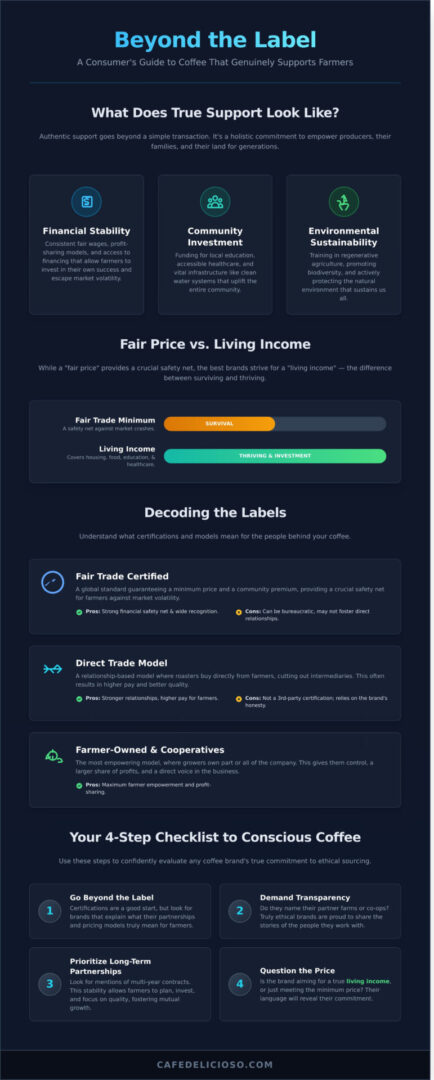
The phrase "ethically sourced" is everywhere, but what does it take for a brand to truly support the people who grow our coffee? It’s about creating a system of empowerment that goes far beyond paying a slightly higher price for a single harvest. True support rests on three pillars: financial stability, community investment, and environmental sustainability.
This means providing farmers with fair wages and access to financing, investing in local education and healthcare, and offering training in regenerative agriculture to protect the land for future generations. It’s about building a partnership, not just completing a transaction.
Fair Price vs. Living Income
You’ve likely heard of the Fair Trade minimum price, which acts as a crucial safety net when market prices crash. However, the most impactful brands aim higher, striving for a living income—the amount a family needs to afford a decent standard of living, including food, housing, education, and healthcare. While a fair price prevents disaster, a living income allows farming families to thrive.
Long-Term Partnerships, Not Just Transactions
Imagine trying to run a business without knowing if you’ll have any customers next year. That’s the reality for many coffee farmers. Long-term contracts give them the security to plan, invest in their farms, and innovate. These stable partnerships foster mutual growth, leading to higher-quality coffee for you and a more secure future for them. When a brand commits to a farmer or cooperative year after year, it’s a powerful statement of support.
Decoding the Labels: Fair Trade, Direct Trade, & B Corp Explained
Navigating the world of ethical coffee can be confusing. Certifications and sourcing models are not one-size-fits-all, and the best one often depends on the brand’s goals and the farmers’ needs. Here’s a clear breakdown of the most common labels you’ll encounter.
Fair Trade Certified: The Global Standard
Fair Trade is one of the most recognized third-party certifications. It guarantees a minimum price for coffee and provides an additional community development premium that farmers can invest in projects like building schools or improving infrastructure.
- Pros: It offers a strong safety net, has wide consumer recognition, and empowers communities through the development premium.
- Cons: The process can be bureaucratic, and it doesn’t always foster a close, personal relationship between the roaster and the farmer.
Direct Trade: Building Relationships
Direct Trade is a model, not a certification, where roasters buy coffee directly from farmers or cooperatives. By cutting out intermediaries, they can often pay a higher price to the producer and gain more control over quality.
- Pros: This model often leads to the highest prices for farmers, encourages exceptional quality, and builds strong, lasting partnerships.
- Cons: It relies entirely on the brand’s transparency and integrity, as there is no third-party oversight to verify claims.
Farmer-Owned & Cooperatives
Some of the most impactful brands are structured as cooperatives, where the farmers themselves own a part or all of the company. This model gives producers a seat at the table, ensuring they have more control over their business and receive a larger share of the final profits. Supporting a farmer-owned brand means your money flows directly back to the people who grew the beans.
10 Coffee Brands Making a Real Impact in 2025
Navigating the world of ethical coffee can be complex, with various certifications and sourcing models. To simplify your search, we’ve curated a list of standout coffee brands that support farmers through impactful and transparent practices. From pioneering Direct Trade to empowering entire cooperatives, these companies prove that your morning cup can create positive change.
For the Direct Trade Devotee: Stumptown Coffee Roasters
A true pioneer in the specialty coffee scene, Stumptown built its reputation on a robust Direct Trade model. They forge long-term, personal relationships with producers, paying significant premiums far above market price for exceptional quality. Their commitment to transparency is unmatched, with detailed annual sourcing reports that break down exactly what they pay for their green coffee, fostering accountability and trust.
For the Cooperative Champion: Café Delicioso
Café Delicioso is a model of how a brand can empower an entire community. By partnering directly with the Cocapec cooperative in the Alta Mogiana region of Brazil, they ensure that benefits are shared widely among farming families. This partnership provides farmers with fair, stable payment and crucial support for transitioning to pesticide-free, regenerative farming. Their "Love for the People" ethos is more than a slogan—it’s a commitment to creating a compassionate and sustainable supply chain from bean to bag.
For the Fair Trade Faithful: Equal Exchange
As one of the original Fair Trade brands in the United States, Equal Exchange has been a leader in the ethical food movement for decades. Organized as a worker-owned cooperative, their entire business model is built on fairness and democratic principles. They offer a wide range of high-quality, Fair Trade certified products, proving that a business can be both successful and equitable.
Other Brands to Watch
- Pachamama Coffee: This unique brand is 100% owned by smallholder farmers in Latin America and Africa, ensuring all profits return to the producers.
- Thrive Farmers: They use an innovative revenue-sharing model that gives farmers a percentage of the final sale price, allowing them to earn more when the coffee sells for more.
- Larry’s Coffee: A founding B Corporation, Larry’s focuses on sustainability with every bean, from shade-grown coffee to eco-friendly roasting facilities.
- Peace Coffee: A B Corp that has been 100% Fair Trade and organic since its founding in 1996, with a deep commitment to long-term cooperative partnerships.
- Grounds for Change: This family-owned roaster is committed to social and environmental responsibility, offering 100% organic, Fair Trade, and shade-grown coffee.
- Higher Ground Roasters: They exclusively roast 100% Fair Trade, organic, and shade-grown coffees, donating a portion of their profits to environmental causes.
- Deans Beans: All of their coffee is 100% organic and Fair Trade, and they run people-centered development projects in their source communities.
How to Be a Conscious Coffee Consumer: A 4-Step Checklist
Your purchasing power is a vote for the kind of coffee industry you want to support. This simple checklist helps you vet any brand, not just the ones on our list, turning you from a passive buyer into an informed supporter.
1. Read Beyond the Label
Don’t stop at the certification seal. Look for details on the bag. Does it mention the specific region, cooperative, or even the farmer’s name? Vague marketing terms like "ethically sourced" without any proof are a red flag. The more specific the information, the more likely the brand has a genuine connection to its source.
2. Scrutinize the Website
Transparent brands are proud to share their sourcing stories. Dive into their "About Us" or "Sourcing" pages. Do they provide specific details about their partners? Do they explain their pricing model? Great brands often have a FAQ section answering tough questions about their practices.
3. Understand the Price
If a bag of coffee seems too cheap, it probably is. Ethically sourced coffee costs more because more of the money you pay goes directly to the people who grew it. Think of the higher price not as an expense, but as an investment in quality, sustainability, and human dignity.
4. Ask Questions and Share
Don’t be afraid to engage. If a brand’s website is vague, send them an email or a message on social media asking for more details about their farmer partnerships. When you find a brand doing amazing work, share it with your friends and family. Your voice can help raise the bar for the entire industry.
The Café Delicioso Difference: Compassion in Every Cup
At Café Delicioso, our commitment to farmers is the heart of our brand. We believe that exceptional coffee is grown from a foundation of respect, fairness, and true partnership. We’ve focused our efforts on the Alta Mogiana region of Brazil, allowing us to invest deeply in the land and its people.
Our Partnership with the Cocapec Cooperative
Instead of working with individual farms, we partner with the Cocapec cooperative. This ensures that the benefits of our partnership—from fair prices to agricultural resources—are distributed across the entire community. This direct relationship gives us complete traceability from the farm to your cup and allows us to provide hands-on support for their transition to pesticide-free, regenerative farming techniques.
‘Love for the People, Love for the Land’
Our ethos, "Love for the People, Love for the Land," guides every decision we make. It means ensuring fair labor practices and safe working conditions for every person who touches our coffee. It means promoting farming methods that restore soil health, protect biodiversity, and create a resilient ecosystem. This holistic approach is how we craft premium coffee with a purpose, resulting in a brew that is as good for the world as it is for your morning ritual.
Taste the difference compassion makes.
Frequently Asked Questions
Is ‘ethically sourced’ coffee the same as Fair Trade coffee?
Not necessarily. "Ethically sourced" is a broad marketing term without a regulated definition. Fair Trade is a specific, third-party certification with clear standards. A brand can be ethical without being Fair Trade (like many Direct Trade models), but the term itself requires you to look for proof of their specific practices.
Does supporting farmers mean the coffee is also organic?
No, these are separate issues, though they often overlap. A brand can pay fair prices for conventionally grown coffee. However, many brands that support farmers also invest in sustainable and organic farming practices because a healthy environment is crucial for the long-term well-being of farming communities.
How can I be sure a brand’s claims about supporting farmers are true?
Look for transparency and specificity. Trustworthy brands provide details: the names of their partner cooperatives, the prices they pay, and stories from the farmers themselves. Third-party certifications like Fair Trade and B Corp also provide a level of external verification.
Why is Direct Trade coffee often more expensive than Fair Trade?
Direct Trade roasters often focus on the highest-quality micro-lots of coffee and pay a significant premium for that quality. By removing intermediaries, more of that premium can go to the farmer. Fair Trade sets a minimum price floor, but Direct Trade prices are often set much higher based on the coffee’s quality score.
What is a coffee cooperative and how does it help farmers?
A coffee cooperative is a business owned and operated by the farmers themselves. By pooling their resources, they can achieve economies of scale, negotiate better prices, access financing, and share knowledge. This structure gives smallholder farmers more power in the global market.
Can buying just one bag of coffee really make a difference for a farmer?
Yes, absolutely. Every purchase is a signal to the market that you value fairness and sustainability. Your choice, combined with the choices of thousands of others, creates the demand that allows ethical brands to grow and expand their positive impact, providing more farmers with stable, long-term partnerships.